Looking like bubbles or smoke rings, these half-inch chains, loops, and spheres are actually common planktonic animals called colonial radiolarians. Each soft shape is hundreds of single-celled animals embedded in a jelly-like substance. Drifting in the ocean’s surface waters, they can photosynthesize but are also predators on other small plankton. These were collected by Laurence Madin of the Biology Department on a 2006 cruise to explore the deep Sargasso Sea. The cruise aboard the NOAA vessel R/V Ronald H. Brown brought together plankton specialists from nine countries as part of the Census of Marine Zoolankton project, a large-scale effort to collect, identify, and make species-identifying DNA “barcodes” for all the world’s ocean’s animal plankton, including newly-discovered species. (Photo by Laurence Madin, Woods Hole Oceanographic Institution)
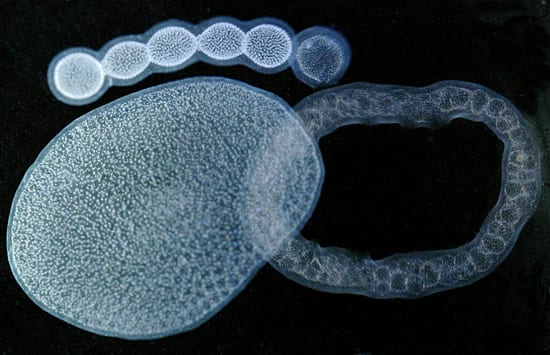
Image and Visual Licensing
WHOI copyright digital assets (stills and video) on this website can be licensed for non-commercial use upon request and approval. Please submit your request via our Media Request Form.
For assistance or accessibility accommodations, call (508) 289-2647.