Ocean Elevator — A Virtual Descent Through the Ocean's Five Depth Zones
An interactive scroll-driven journey by Woods Hole Oceanographic Institution (WHOI). Visitors descend from sea level to the Challenger Deep at roughly 11,000 meters, encountering 177 marine organisms and ocean features and 16 depth milestones along the way. Real-time readouts track depth (ft/m), pressure (ATM/PSI), temperature (°F/°C), and the visible-light spectrum that survives at each depth.
Sunlit Zone (Epipelagic): 0–200m
The Sunlit Zone (epipelagic) extends from the surface to 200 meters. Sunlight penetrates this zone, supporting photosynthesis and the vast majority of marine life — from plankton to whales. Temperatures are warm and variable, and most familiar ocean creatures live here.
You're in the sunlit zone!
Depth: 0m · Type: Ocean zone callout
The surface is home to a massive number of organisms large and small. In this layer, phytoplankton produce about half the oxygen on Earth.
Source: https://ocean.si.edu/ocean-life/plankton/every-breath-you-take-thank-ocean
Atlantic needlefish (Strongylura marina)
Depth: 1m · Depth range: 0–1.5m · Average length: 60 cm · Tags: Organism, Fish, Predator
Slender fish with elongated jaws, often found near the surface.
Source: iNaturalist
Salp (Salpidae (family))
Depth: 3m · Average length: 0.25 m · Tags: Organism, Filter feeder
Barrel-shaped, transparent free-floating tunicates that pump seawater through their bodies to filter out phytoplankton. Salps reproduce rapidly into long chains and play an outsized role in the ocean's carbon cycle—their dense fecal pellets sink quickly, transporting carbon from surface waters to the deep sea.
Source: https://ocean.si.edu/ocean-life/invertebrates/salps
Krill (Meganyctiphanes norvegica)
Depth: 7m · Depth range: 0–100m · Average length: 2 cm · Tags: Organism, Crustacean, Filter feeder, Migratory
Small shrimp-like crustaceans that form some of the largest swarms of any animal on Earth. They are a foundational food source for whales, seals, seabirds, and fish, and participate nightly in diel vertical migration — rising toward the surface to feed and retreating to depth during the day.
Source: https://inaturalist.ca/taxa/153112-Euphausiacea
Lion's mane jelly (Cyanea capillata)
Depth: 7m · Depth range: 0–20m · Average length: 36.6 m · Tags: Organism, Cnidarian, Predator
Large jellyfish with flowing tentacles resembling a lion's mane. It's bell, or main body, can exceed 1 meter (~3 feet) in diameter and tentacles can be up to 30 meters (~98 feet) long.
Source: https://inaturalist.ca/taxa/69838-Cyanea-capillata
Mahi mahi (Coryphaena hippurus)
Depth: 7m · Depth range: 0–1m · Average length: 2.1 m · Tags: Organism, Fish, Predator
The name "Mahi-mahi" is Hawaiian for "very strong."
Source: MBARI "Animals A to Z"
Snapping shrimp (Alpheidae)
Depth: 10m · Depth range: 0–10m · Average length: 4 cm · Tags: Organism, Crustacean
Small crustacean that creates a 210 decible snapping sound with its claw to stun prey.
Source: https://inaturalist.ca/taxa/51196-Alpheidae
Blue ringed octopus (Hapalochlaena lunulata)
Depth: 10m · Depth range: 0–20m · Average length: 10 cm · Tags: Organism, Mollusk, Predator
Small but highly venomous octopus with distinctive blue rings.
Source: https://inaturalist.ca/taxa/199917-Hapalochlaena-lunulata
North Atlantic right whales (Eubalaena glacialis)
Depth: 16m · Depth range: 0–170m · Average length: 14.5 m · Tags: Organism, Cetacean, Filter feeder, Endangered
One of the world's most endangered large whale species, with fewer than 370 individuals remaining. They feed by skimming dense patches of copepods near the surface and are critically threatened by vessel strikes and entanglement in fishing gear.
Source: https://www.fisheries.noaa.gov/species/north-atlantic-right-whale
Stoplight parrotfish (Sparisoma viride)
Depth: 16m · Depth range: 3–25m · Average length: 45 cm · Tags: Organism, Fish
Colorful reef fish that feeds on algae and coral.
Source: https://inaturalist.ca/taxa/1455139-Scarini
Green sea turtle (Chelonia mydas)
Depth: 20m · Depth range: 0–140m · Average length: 1.5 m · Tags: Organism, Reptile, Endangered
The only sea turtle that is strictly herbivorous as an adult, grazing on seagrasses and algae which give its body fat the greenish tint that earned the species its name. Green turtles undertake long migrations between feeding grounds and natal nesting beaches.
Source: https://www.fisheries.noaa.gov/species/green-turtle
Steller sea lion (Eumetopias jubatus)
Depth: 20m · Depth range: 0–250m · Average length: 2.75 m · Tags: Organism, Pinniped
The largest of the eared seals, with males reaching over 1,000 kg. They forage on fish, squid, and octopus in the North Pacific and can dive to nearly 300 meters. Listed as a species of concern after major population declines in the western range.
Source: https://www.fisheries.noaa.gov/species/steller-sea-lion
Atlantic spotted dolphin (Stenella frontalis)
Depth: 21m · Depth range: 0–60m · Average length: 2.26 m · Tags: Organism, Cetacean
These communal dolphins live in groups of up to 50. Google is training an AI model to decipher their language.
Source: https://inaturalist.ca/taxa/41503-Stenella-frontalis
Striped bass (Morone saxatilis)
Depth: 23m · Depth range: 0–40m · Average length: 70 cm · Tags: Organism, Fish
Popular game fish with distinctive horizontal stripes.
Source: iNaturalist: https://www.inaturalist.org/taxa/51392-Morone-saxatilis
Blue crab (Callinectes sapidus)
Depth: 23m · Depth range: 0–35m · Average length: 23 cm · Tags: Organism, Crustacean
Important commercial crustacean with distinctive blue claws.
Source: https://www.inaturalist.org/taxa/49504-Callinectes-sapidus
Depth: 24m
CUREE
Depth: 25m · Tags: Vehicle, Autonomous, Active
A WHOI reef-exploration AUV compact enough to be flown as checked airline luggage and deployed by a single operator. CUREE "hops" through a reef — moving in short bursts, then setting down to listen and observe — so it can stalk fish, record snapping-shrimp soundscapes, and study coral ecosystems without disturbing them.
Source: https://warp.whoi.edu/curee/
Barred filefish (Cantherhines dumerilii)
Depth: 26m · Depth range: 0–70m · Average length: 25 cm · Tags: Organism, Fish
Compressed fish with rough, file-like skin texture.
Source: https://www.inaturalist.org/taxa/130765-Cantherhines-dumerilii
Walrus (Odobenus rosmarus)
Depth: 27m · Depth range: 0–30m · Average length: 2.9 m · Tags: Organism, Pinniped
Large Arctic marine mammal with distinctive "tusks" that are actually teeth.
Source: https://www.fisheries.noaa.gov/species/pacific-walrus
Atlantic horseshoe crab (Limulus polyphemus)
Depth: 30m · Depth range: 0–30m · Average length: 60 cm · Tags: Organism, Ancient
A living fossil more closely related to spiders than to crabs, essentially unchanged for over 400 million years. Their distinctive blue, copper-based blood is uniquely sensitive to bacterial contamination and is harvested by the biomedical industry to test the safety of vaccines and medical devices.
Source: https://inaturalist.ca/taxa/48302-Limulus-polyphemus
No WiFi or radio beyond this point
Depth: 30m · Type: Depth milestone
Harbor seal (Phoca vilutina)
Depth: 33m · Depth range: 0–500m · Average length: 1.85 m · Tags: Organism, Pinniped
Coastal seal species that can dive to impressive depths.
Source: https://inaturalist.ca/taxa/41708-Phoca-vitulina
Blue whale (Balaenoptera musculus)
Depth: 39m · Depth range: 0–100m · Average length: 22.5 m · Tags: Organism, Cetacean, Filter feeder, Endangered
Largest animal ever known, reaching over 100 feet in length.
Source: https://www.fisheries.noaa.gov/species/blue-whale
BIKE TIRE PRESSURE
Depth: 44m
Pressure here matches the air in a bike tire (65 psi)
Northern Pacific anchovy (Engraulis mordax)
Depth: 45m · Depth range: 0–310m · Average length: 23 cm · Tags: Organism, Fish, Filter feeder, Migratory
Small schooling fish vital to the marine food chain.
Source: https://www.montereybayaquarium.org/animals/animals-a-to-z/northern-anchovy
Common dolphin (Delphinus delphis)
Depth: 48m · Depth range: 0–200m · Average length: 2.2 m · Tags: Organism, Cetacean
Highly intelligent marine mammal with distinctive hourglass pattern.
Source: https://inaturalist.ca/taxa/41526-Delphinus-delphis
Great hammerhead (Sphyrna mokarra)
Depth: 50m · Depth range: 0–80m · Average length: 4.6 m · Tags: Organism, Shark, Predator, Endangered
Large shark species with distinctive hammer-shaped head.
Source: https://www.inaturalist.org/taxa/56766-Sphyrna-mokarran
Yellowtail (Seriola dorsalis)
Depth: 54m · Depth range: 3–825m · Average length: 85 cm · Tags: Organism, Fish, Predator
Fast-swimming fish popular in both sport fishing and cuisine.
Source: https://inaturalist.ca/taxa/1316790-Seriola-dorsalis
Humpback whale (Megaptera novaeangliae)
Depth: 60m · Depth range: 0–80m · Average length: 15.5 m · Tags: Organism, Cetacean, Filter feeder, Migratory
Massive whale known for complex songs, acrobatic breaching, and distinctive white pectoral fins.
Source: https://www.inaturalist.org/taxa/41566-Megaptera-novaeangliae
Shortfin mako shark (Isurus oxyrinchus)
Depth: 64m · Depth range: 0–150m · Average length: 4 m · Tags: Organism, Shark, Predator, Endangered
The fastest known shark, reaching speeds of up to 46mph.
Source: https://inaturalist.ca/taxa/69677-Isurus-oxyrinchus
Spiny dogfish (Squalus acanthias)
Depth: 65m · Depth range: 50–149m · Average length: 72 cm · Tags: Organism, Shark
Small shark species commonly found in temperate waters.
Source: https://www.inaturalist.org/taxa/52306-Squalus-acanthias
Max depth perceived by satellite
Depth: 70m · Type: Depth milestone
Source: https://www.usgs.gov/centers/eros/news/usgs-finds-new-way-measure-ocean-depth-landsat
Plumose anemone (Metridium senile)
Depth: 75m · Depth range: 20–100m · Average length: 30 cm · Tags: Organism, Cnidarian, Filter feeder
Large anemone with numerous fine tentacles that capture small praey with stinging cells. Can form colonies
Source: https://www.inaturalist.org/taxa/49071-Metridium-senile
Atlantic mackerel (Scomber scombrus)
Depth: 78m · Depth range: 0–200m · Average length: 30 cm · Tags: Organism, Fish, Migratory
Fast-swimming schooling fish with tiger-like stripes.
Source: iNaturalist
Ocean sunfish (Mola mola)
Depth: 78m · Depth range: 0–200m · Average length: 2.5 m · Tags: Organism, Fish
The heaviest bony fish in the world, feeds mostly on jellyfish.
Source: https://inaturalist.ca/taxa/49601-Mola-mola
Bottlenose dolphin (Tursiops truncatus)
Depth: 82m · Depth range: 20–200m · Average length: 3 m · Tags: Organism, Cetacean
Most well-known dolphin species, highly social and intelligent. Noted to use higher-pitched whistles around their calves, similar to the way humans baby-talk to their infants.
Source: iNaturalist
Orca (Orcinus orca)
Depth: 83m · Depth range: 20–300m · Average length: 7 m · Tags: Organism, Cetacean, Predator
Apex predator also known as killer whale, highly intelligent.
Source: https://www.fisheries.noaa.gov/species/killer-whale
Yellowfin tuna (Thunnus albacares)
Depth: 87m · Depth range: 0–88m · Average length: 1.7 m · Tags: Organism, Fish, Predator, Migratory
Fast-swimming tuna with distinctive yellow fins.
Source: https://inaturalist.ca/taxa/69675-Thunnus-albacares
Whale shark (Rhincodon typus)
Depth: 92m · Depth range: 0–500m · Average length: 14.5 m · Tags: Organism, Shark, Filter feeder, Endangered
World's largest fish, a gentle giant filter feeder.
Source: https://inaturalist.ca/taxa/52188-Rhincodon-typus
Deepest technical dive
Depth: 100m · Type: Depth milestone
The deepest recorded technical scuba dive reached 332 meters.
Bowhead whale (Balaena mysticetus)
Depth: 110m · Depth range: 0–150m · Average length: 16 m · Tags: Organism, Cetacean, Filter feeder
Arctic whale that can live more than 200 years, which gives it the longest known lifespan among mammals. It also has the largest mouth of the animal kingdom.
Source: iNaturalist
Atlantic cod (Gadus morhua)
Depth: 115m · Depth range: 0–300m · Average length: 1.2 m · Tags: Organism, Fish, Endangered
Important commercial fish species of the North Atlantic. One of the most heavily fished species. Collapse of the several stocks in the 90's was devastating
Source: https://www.inaturalist.org/taxa/63740-Gadus-morhua
Great white shark (Carcharodon carcharias)
Depth: 122m · Depth range: 0–1200m · Average length: 4.45 m · Tags: Organism, Shark, Predator
Legendary apex predator and largest predatory fish.
Source: https://inaturalist.ca/taxa/50873-Carcharodon-carcharias
Coelocanth (Latimeria chalumnae)
Depth: 140m · Depth range: 70–140m · Average length: 1.98 m · Tags: Organism, Fish, Ancient, Endangered
The species was believed to have gone extinct over 65 million years ago but was rediscovered off the coast of South Africa in 1938.
Source: NOAA Fisheries Species Directory
Summer flounder (Paralichthys dentatus)
Depth: 160m · Depth range: 10–160m · Average length: 44 cm · Tags: Organism, Fish
Flatfish that lies on the ocean floor with both eyes on one side.
Source: https://inaturalist.ca/taxa/53744-Paralichthys-dentatus
Water pressure of an attack fire hose, 275 psi
Depth: 178m
Red snapper (Lutjanus campechanus)
Depth: 186m · Depth range: 9–189m · Average length: 1.016 m · Tags: Organism, Fish
Prized food fish with distinctive reddish coloration.
Source: https://www.fisheries.noaa.gov/species/red-snapper
Thick-billed murre (Uria lomvia)
Depth: 197m · Depth range: 0–200m · Average length: 45 cm · Tags: Organism, Bird
An Arctic bird that can dive 150 meters (~495 feet) deep
Source: https://www.allaboutbirds.org/guide/Thick-billed_Murre/id
Twilight Zone (Mesopelagic): 200–1000m
The Twilight Zone (mesopelagic) spans 200 to 1,000 meters. Light fades to a dim glow that cannot support photosynthesis. The thermocline causes a rapid temperature drop. Bioluminescence becomes common, and the zone is the staging ground for diel vertical migration — the largest daily migration of life on Earth.
Welcome to the Twilight Zone
Depth: 200m · Type: Ocean zone callout
This depth range resembles those eerie moments when day and night overlap. It teems with life and flashes of bioluminescent light. It may contain more biomass than the rest of the ocean combined.
Deepest free-diving depth
Depth: 214m · Type: Depth milestone
Atlantic bluefin tuna (Thunnus thynnus)
Depth: 250m · Depth range: 0–500m · Average length: 1.85 m · Tags: Organism, Fish, Predator, Migratory, Endangered
One of the largest, fastest, and most thermally adapted bony fish in the ocean, capable of warming its body well above the surrounding water. Bluefin can sprint over 65 km/h, cross entire ocean basins, and live more than 30 years — but populations have been heavily depleted by commercial fishing.
Source: https://www.fisheries.noaa.gov/species/western-atlantic-bluefin-tuna
Blue shark (Prionace glauca)
Depth: 280m · Depth range: 0–350m · Average length: 3.8 m · Tags: Organism, Shark, Predator, Migratory
Sleek, oceanic sharks known for the longest migrations of any shark — some crossing entire ocean basins. They feed on squid and small fish and are one of the most heavily caught sharks worldwide, mainly as fisheries bycatch.
Source: MBARI "10 minutes of fascinating deep sea animals"
Entering the thermocline
Depth: 300m
Temperature drops fast here while pressure and density increase.
Source: https://oceanservice.noaa.gov/facts/thermocline.html
Deepest SCUBA dive
Depth: 332.35m · Type: Depth milestone
Chambered nautilus (Nautilus pompilius)
Depth: 345m · Depth range: 70–700m · Average length: 19 cm · Tags: Organism, Mollusk, Ancient
An ancient cephalopod whose ancestors swam Earth's seas more than 500 million years ago. It controls buoyancy by adjusting gas and fluid in the sealed chambers of its spiral shell, drifting up and down the reef walls at night to scavenge for food.
Source: MBARI "Animals A to Z"
Krill (Meganyctiphanes norvegica)
Depth: 405m · Depth range: 0–500m · Average length: 2 cm · Tags: Organism, Crustacean, Filter feeder, Migratory
Daytime resting depth for many krill, which migrate hundreds of meters between deep waters and the surface every 24 hours. This nightly journey is part of the largest animal migration on Earth — the diel vertical migration of the deep scattering layer.
Source: https://inaturalist.ca/taxa/153112-Euphausiacea
It's getting darker…
Depth: 420m
Animals may have large eyes to see what little light penetrates here. They may even be able to make their own light through bioluminescence. In some cases, the animals are home to bacteria which actually produce light.
Hatchetfish (Argyropelecus olfersii)
Depth: 438m · Depth range: 100–900m · Average length: 9 cm · Tags: Organism, Fish, Bioluminescent
A small, mirrored mesopelagic fish named for its hatchet-shaped body. Light-producing organs along its belly precisely match the faint sunlight filtering down from above, a strategy called counter-illumination that erases its silhouette from predators looking up.
Source: https://inaturalist.ca/taxa/459329-Argyropelecus-olfersii
<i>Mesobot</i>
Depth: 465m · Depth range: 0–1000m · Average length: 1 m · Tags: Vehicle, Autonomous, Active
A hybrid midwater robot, whose development was led by Dana Yoerger at WHOI and in collaboration with colleagues from WHOI, MBARI, Stanford, and Univeristy of Texas Rio Grande Valley. Mesobot follows midwater animals through the ocean twilight zone without spooking them. Powered for more than 24 hours on lithium-ion batteries, it uses slow, large propellers and red lights—invisible to most deep-sea species—to observe and sample without disturbance. Mesobot can also carry eDNA samplers, to autonomously collect genetic traces of midwater animals.
Source: https://www.whoi.edu/what-we-do/explore/underwater-vehicles/auvs/mesobot/
Lanternfish (Myctophidae (family))
Depth: 475m · Depth range: 200–1500m · Average length: 15 cm · Tags: Organism, Fish, Bioluminescent, Migratory
Bioluminescent fish that migrates to surface at night. There are 246 species in the family Myctophidae.
Source: https://twilightzone.whoi.edu/explore-the-otz/creature-features/lanternfish/
Dwarf lanternshark (Etmopterus perryi)
Depth: 493m · Depth range: 283–439m · Average length: 14 cm · Tags: Organism, Shark, Bioluminescent
Record smallest shark of 2017. The specimen pictured here was discovered in the Caribbean Sea off the coast of Colombia in 1985 at a depth of 290 m (950 ft).
Source: Smithsonian Ocean
Common fangtooth (Anoplogaster cornuta)
Depth: 500m · Depth range: 0–500m · Average length: 17 cm · Tags: Organism, Fish, Predator
Despite its menacing appearance and proportionally largest teeth of any ocean fish, the fangtooth is only about the length of a human hand. It lives in deep, dark waters and migrates upward at night to hunt small fish and crustaceans.
Source: https://ocean.si.edu/ocean-life/fish/common-fangtooth
<i>Deep-See</i>
Depth: 510m · Depth range: 0–1000m · Average length: 4.87 m · Tags: Vehicle, Tethered, Active
A WHOI-built towed sensor platform that surveys the ocean twilight zone, packed across three modular sections with sonars, cameras, an environmental-DNA sampler, and a CTD. Towed at roughly 1 m/s on an electro-optical cable to 1,000 meters, it streams data and imagery to the ship in real time across ~23-hour deployments.
Source: https://www.whoi.edu/what-we-do/explore/underwater-vehicles/towed-vehicles/deep-see/
Strawberry squid (Histioteuthis heteropsis)
Depth: 520m · Depth range: 0–1000m · Average length: 20 cm · Tags: Organism, Mollusk, Bioluminescent
A mesopelagic squid named for the red, strawberry-like spots covering its body. It has two strikingly mismatched eyes: a large yellow upward-facing eye that searches for silhouettes in the dim light above, and a smaller blue eye that scans below for bioluminescent flashes.
Source: https://www.mbari.org/news/strawberry-squid-mismatched-eyes/
Emperor penguin (Aptenodytes forsteri)
Depth: 540m · Depth range: 0–565m · Average length: 1.2 m · Tags: Organism, Bird
Largest penguin species, can dive to over 500 meters(~1640 feet), making it the deepest-diving bird.
Source: https://www.inaturalist.org/taxa/3820-Aptenodytes-forsteri
Diel vertical migration
Depth: 550m
As the sun sets many animals living in the ocean twilight zone rise up to the surface to feed on plankton and other microorganisms. When the sun reappears at dawn, they descend back to the depths. This is the largest migration of animal life on earth.
Japanese spider crab (Macrocheira kaempferi)
Depth: 580m · Depth range: 50–600m · Average length: 3.8 m · Tags: Organism, Crustacean
The world's largest living crab.
Source: MBARI "Animals A to Z"
Naked sea angel (Clione limacina)
Depth: 600m · Depth range: 0–600m · Average length: 6 cm · Tags: Organism, Mollusk
A large sea slug without a shell that lives in cold water and preys on shelled pteropods.
Source: iNaturalist
Bristlemouth (Cyclothone sp.)
Depth: 600m · Depth range: 100 - ~5000m · Average length: 3 cm · Tags: Organism, Fish, Bioluminescent
These fish are the most abundant vetabrete on earth, with estimates in the trillions or quadrillions!
Source: https://www.fishbase.se/summary/Gonostoma-elongatum.html
Oceanic manta ray (Mobula birostris)
Depth: 640m · Depth range: 0–1000m · Average length: 4.5 m · Tags: Organism, Ray, Filter feeder
The largest ray in the ocean, with a wingspan that can exceed 7 meters. Highly intelligent and one of the few fish that can recognize themselves in a mirror, oceanic mantas filter-feed on zooplankton and routinely dive past 1,000m, likely to forage in the deep scattering layer.
Source: https://www.inaturalist.org/taxa/623966-Mobula-birostris
Barreleye (Macropinna microstoma)
Depth: 675m · Depth range: 600–800m · Average length: 15 cm · Tags: Organism, Fish
Has eyes pointing upward within a transparent dome that it can rotate to look forward.
Source: MBARI "Animals of the Deep"
Humboldt squid (Dosidicus gigas)
Depth: 695m · Depth range: 200–700m · Average length: 2.5 m · Tags: Organism, Mollusk, Predator
Unlike most cephalopods, who have a reputation for being solitary, humboldt squids are pack hunters that communicate via bioluminesce to coordinate attacks. You may recognize them from the Nat Geo Wild documentary "Man Eating Super Squid: A Monster Invasion" & BBC's Blue Planet II.
Source: iNaturalist
Deepest saturation dive
Depth: 701m · Type: Depth milestone
Saturation divers will spend as long as a month working at depths between 20m to 300m, after which their bodies are completely saturated with dissolved nitrogen. To reascend without injury, divers are first brought to the surface by a pressurized diving bell, then to specialized chambers for decompression. They are often needed for underwater construction, salvage operations, and maintenance of oil and gas rigs or pipelines.
Longnose Lancetfish (Alepisaurus ferox)
Depth: 720m · Depth range: 0–1830m · Average length: 2.15 m · Tags: Organism, Fish, Predator
Also known as "cannibal fish," they are an important middleman in deep water food webs. They migrate daily between the sunlit and midnight zones in search of prey, and are a food source for yellowfin tuna, opah, fur seals, Pacific cod, and salmon sharks.
Source: https://www.inaturalist.org/taxa/93644-Alepisaurus-ferox
North Atlantic Swordfish (Xiphias gladius)
Depth: 750m · Depth range: 0–2878m · Average length: 3 m · Tags: Organism, Fish, Predator, Migratory
Atlantic swordfish are one of the fastest predators in the ocean. Their streamlined body allows them to swim at high speeds, up to 50 mph. In 2000, their population had dropped to 65% of the target level, but was fully rebuilt by 2009 through implementing more sustainable fishing practices
Source: Fishbase USA
Pacific viperfish (Chauliodus macouni)
Depth: 750m · Depth range: 200–1500m · Average length: 30 cm · Tags: Organism, Fish, Predator, Bioluminescent
A small but ferocious mesopelagic predator with fangs so long they don't fit inside its mouth. A glowing photophore at the tip of its dorsal spine allows for signaling, attracting mates, and luring curious prey within striking range.
Source: MBARI "Animals of the Deep"
Vampire squid (Vampyroteuthis infernalis)
Depth: 900m · Depth range: 600–900m · Average length: 30 cm · Tags: Organism, Mollusk
Despite its name ("vampire squid from hell"), this small cephalopod is gentle and eats marine snow — drifting flakes of organic detritus. It lives in oxygen-minimum zones where few other animals can survive and produces clouds of glowing mucus instead of ink when threatened.
Source: MBARI "Animals of the Deep"
Sperm whale (Physeter macrocephalus)
Depth: 900m · Depth range: 0–1000m · Average length: 14 m · Tags: Organism, Cetacean, Predator
AI has revealed that sperm whale songs utilize a phonetic alphabet similar to those found in human languages.
Source: NOAA Fisheries Species Directory
Gossamer worm (Tomopteris sp.)
Depth: 950m · Depth range: 0–3700m · Average length: 60 cm · Tags: Organism, Worm
This worm can produce unique yellow bioluminescence to distract predators. It hunts for zooplankton and swims so quickly and efficiently that engineers are using it as a model for underwater robots.
Source: MBARI "Animals of the Deep"
Phronima amphipod (Phronima sp.)
Depth: 985m · Depth range: 200–1000m · Tags: Organism, Biology
Nicknamed the "pram bug," this transparent twilight-zone amphipod hollows out the body of a salp or siphonophore to make a barrel-shaped home — then pushes the barrel through the water like a baby carriage while brooding her young inside. Reportedly inspired the design of the creature in the film Alien.
Source: https://www.sciencedirect.com/science/article/pii/S001282521830429X
Cockatoo squid (Galiteuthis pyllura)
Depth: 990m · Depth range: 200-1500m · Average length: 3.5 m · Tags: Organism, Mollusk
A transparent, gelatinous deep-sea squid whose body is mostly water-filled tissue. Tucked-up arms held over its head give it a crest-like silhouette resembling a cockatoo, and its mantle is dotted with tiny photophores used to hide its outline from below.
Source: https://www.inaturalist.org/taxa/432421-Galiteuthis-phyllura
Midnight Zone (Bathypelagic): 1000–4000m
The Midnight Zone (bathypelagic) reaches from 1,000 to 4,000 meters. No sunlight penetrates. Water hovers near 4°C and pressure is crushing. Life is sparse but specialized: anglerfish, vampire squid, gulper eels, and the ecosystems around hydrothermal vents and whale falls.
Welcome to the Midnight Zone
Depth: 1000m · Type: Ocean zone callout
This is largest habitat on the planet. All light in the ocean has vanished—except bioluminescence—and temperatures are near freezing. Many animals do not have eyes or have specialized sensors to see. They find mates, communicate, and find food using bioluminescence, sound, vibration, and scents.
Short-finned pilot whale (Globicephala macrorhynchus)
Depth: 1025m · Depth range: 0–700m · Average length: 5.49 m · Tags: Organism, Cetacean
Highly social toothed whales that travel in tight-knit family pods. They hunt squid with explosive sprint dives — sometimes called "cheetahs of the deep" — descending more than 600 meters in pursuit of prey before returning to the surface.
Source: https://www.fisheries.noaa.gov/species/short-finned-pilot-whale
Siphonophore (Siphonophorae (order))
Depth: 1025m · Depth range: 0–100m · Average length: 20 m · Tags: Organism, Cnidarian, Predator
Siphonophores are predators that use stinging cells and tentacles to catch prey, ranging from tiny crustaceans to fish. There are hundreds of species living in surface to deep waters, from a few centimeters to many meters in size. Apolemia is the only genus known to reach tens of meters in length.
Source: https://www.mbari.org/animal/siphonophores/
Depth: 1040m
Giant squid (Architeuthis dux)
Depth: 1100m · Depth range: 300–1000m · Average length: 9.5 m · Tags: Organism, Mollusk, Predator
The first ever live recording of a giant squid in its natural habitat was taken in 2012, at a depth of 900 meters. The largest recorded giant squid was 13 meters (~43 feet) long.
Source: iNaturalist
Baby, it's cold outside.
Depth: 1150m
Temperatures here are relatively consistent between 0-3°C. If you're diving in Alvin, it's time to put on another layer. Even with the heat from three people and electronics, the inside of the vehicle can drop as low as 4°F.
Leatherback turtle (Dermochelys coriacea)
Depth: 1200m · Depth range: 0–1200m · Average length: 2.7 m · Tags: Organism, Reptile, Migratory, Endangered
The largest sea turtle and the deepest-diving reptile in the ocean, regularly diving past 1,000m in pursuit of jellyfish. Its leathery, oil-saturated shell and unique counter-current heat exchange allow it to forage from tropical seas to subpolar waters.
Source: https://www.fisheries.noaa.gov/species/leatherback-turtle
Force of Mike Tyson's punch
Depth: 1200m
Water pressure here equals that of Mike Tyson's punch(1800 psi)
Marine Snow
Depth: 1275m
In most parts of the mesopelagic, marine snow is the most conspicous thing you see. Each tiny flake is a clump of marine detritus: dead microscopic animals called plankton, poop, bacteria, and other carbon-rich particles that together provide a rich source of food for deep-sea fish, jellies, and crustaceans.
This deep current is part of the AMOC (Atlantic Meridional Overturning Circulation).
Depth: 1325m
Over thousands of years, this system of currents circulates water throughout the world's oceans
Depth: 1375m
Seawater here last saw the surface during the peak of the Mayan civilization, acting as a time capsule of climate conditions back then.
Depth: 1410m
Frilled shark (Chlamydoselachus anguineus)
Depth: 1450m · Depth range: 50–1520m · Average length: 1.8 m · Tags: Organism, Shark, Ancient
Sometimes called a "living fossil," this deep-sea shark has changed little in 80 million years. Its eel-like body and 300 backward-curved teeth in 25 rows let it strike like a snake to seize squid and small fish in the perpetual dark.
Source: https://inaturalist.ca/taxa/47302-Chlamydoselachus-anguineus
Greenland shark (Somniosus microcephalus)
Depth: 1450m · Depth range: 0–2200m · Average length: 4.5 m · Tags: Organism, Shark
At 392 +/- 120 years, it has the longest lifespan of all vertebrate species. Its diet includes fish, seals, and polar bears!
Source: https://inaturalist.ca/taxa/112841-Somniosus-microcephalus
Since red light never penetrates the deep, red animals are essentially invisible down here.
Depth: 1485m
Crystal amphipod (Cystisoma sp.)
Depth: 1500m · Depth range: 0–1500m · Average length: 15 cm · Tags: Organism, Crustacean
The largest hyperiid amphipod, up to 10 centimeters long. The body is completely transparent except for the pigment of its large, reflective eyes, which make up a third of its body length. Found in all the world's oceans.
Source: MBARI "Animals of the Deep"
Blood belly comb jelly (Lampocteis cruentiventer)
Depth: 1500m · Depth range: 250–1500m · Average length: 16 cm · Tags: Organism, Ctenophore
Native to the North Pacific. Discovered and described by WHOI scientist Richard Harbison. Its red coloration allows it to live invisibly in the Twilight Zone, where red wavelengths have been long since filtered out.
Source: MBARI "Animals of the Deep"
Abyssal comb jelly (Beroe abyssicola)
Depth: 1520m · Depth range: 0–2800m · Average length: 7 cm · Tags: Organism, Ctenophore, Bioluminescent
Its red gut prevents it from being lit up from the inside by its bioluminescent prey. Lives in the Arctic Ocean and Northern Pacific.
Source: MBARI "Animals of the Deep"
Unless you're a dragonfish.
Depth: 1540m
Shiny loosejaw (Aristostomias scintillans)
Depth: 1555m · Depth range: 0–1550m · Average length: 23 cm · Tags: Organism, Fish, Bioluminescent, Predator
One of the most commonly sighted dragonfish species of the Pacific, it possess the rare ability to perceive red light at depth, allowing it to pursue a wider variety of prey.
Source: https://www.mbari.org/animal/dragonfish/
These elusive predators possess the rare ability to perceive red light at depth, allowing them to pursue a wider variety of prey
Depth: 1565m
1 mile
Depth: 1609m · Type: Depth milestone
Seamounts are biodiversity hotspots, providing structure for animals to live on and redirecting food-rich currents.
Depth: 1760m
Basket star (Gorgonocephalus eucnemis)
Depth: 1800m · Depth range: 100–1800m · Average length: 75 cm · Tags: Organism, Echinoderm, Filter feeder
The basket star's sprawling mass of branching arms allow it a much larger range of movement than most others in the brittlestar family (Ophiuroidea). The microscopic hooks on its arms allow it to snag prey, which it brings to its mouth located beneath its central disk.
Source: MBARI "Animals of the Deep"
Bubblegum coral (Paragorgia arborea)
Depth: 1830m · Depth range: 50–1800m · Average length: 3 m · Tags: Organism, Cnidarian
The largest bubblegum corals are thousands of years old, creating dense forests along seamounts and submarine canyons – places with a good amount of current so they can filter feed. These "rainforests of the deep" shelter an enormous diversity of fish and invertebrates.
Source: MBARI "Animals of the Deep"
Pressure here equals that of a garbage truck compactor. (2750psi)
Depth: 1875m
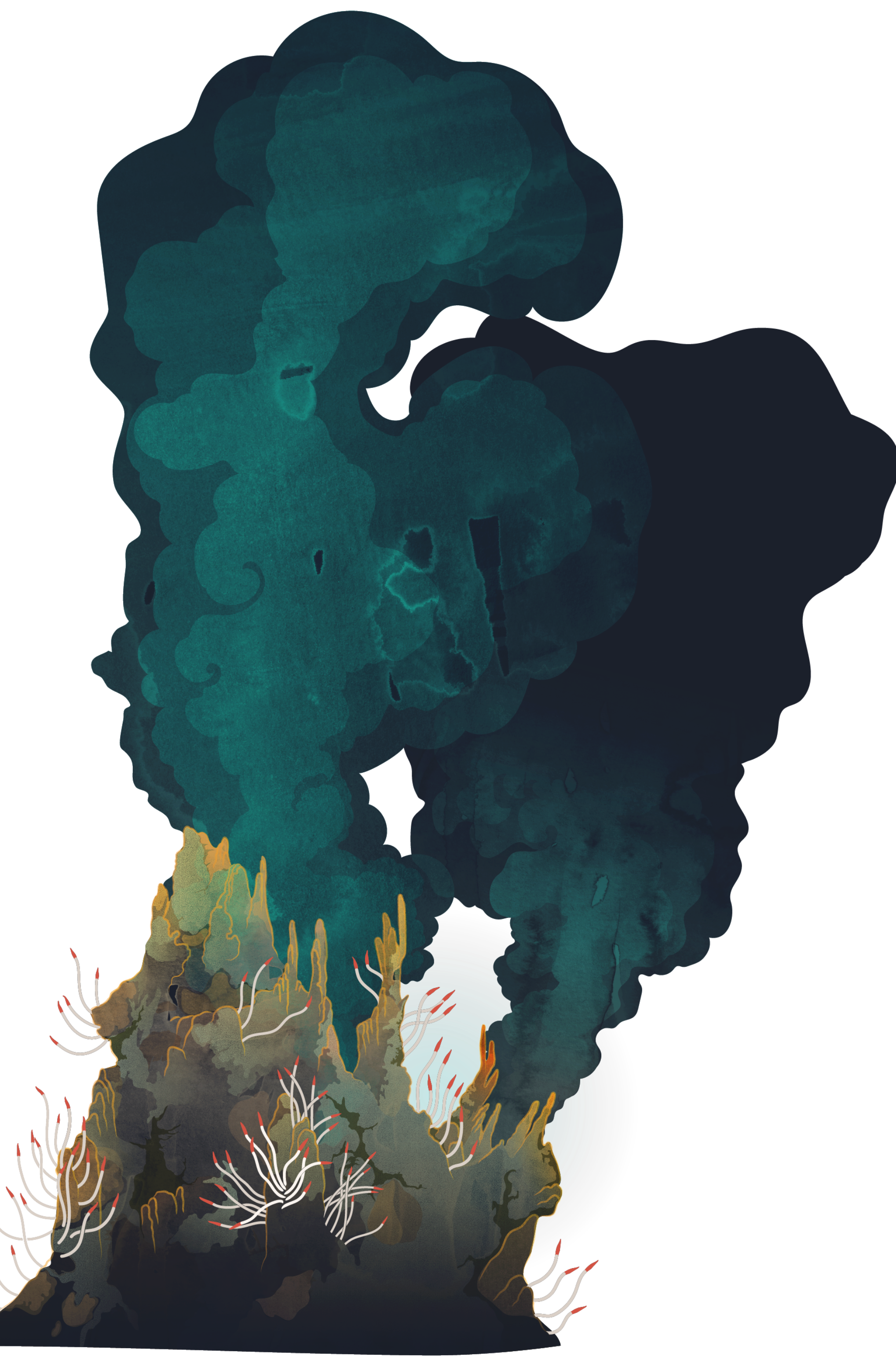
Hydrothermal vents
Depth: 2000m · Type: Depth milestone
Vents are the subsea part of Earth's plumbing system along with geysers and fumaroles on land.
Pocket shark (Mollisquama sp.)
Depth: 2025m · Depth range: 1000–3048m · Average length: 14 cm · Tags: Organism, Shark, Bioluminescent
Not many have been found, but the first specimen was collected off Chile and the second from the Gulf of Mexico, which indicates a very large range.
Source: NOAA fisheries
Giant isopod (Bathynomus giganteus)
Depth: 2075m · Depth range: 170–2100m · Average length: 40 cm · Tags: Organism, Crustacean, Scavenger
The largest isopod species, it is commonly found gorging itself at whale falls. Organs called fat bodies store vast amounts of energy from a single meal, allowing them to go years without food.
Source: MBARI "Animals A to Z"
Black swallower (Chiasmodon niger)
Depth: 2110m · Depth range: 700–2745m · Average length: 1.075 m · Tags: Organism, Fish, Predator
Its flexible stomach allows it to swallow prey up to 3 times its size – an adaptation to its food scarce environment.
Source: https://inaturalist.ca/taxa/317049-Chiasmodon-niger
Psychedelic jelly (Crossota millsae)
Depth: 2160m · Depth range: 1000–3300m · Average length: 3 cm · Tags: Organism, Cnidarian, Bioluminescent
Called 'psychedelic' for it's red pigmentation and bright bioluminescence. Females brood their young, nourishing them with food from their bell until the babies are ready to swim off on their own.
Source: MBARI "Animals of the Deep"
Anglerfish (Melanocetus johnsonii)
Depth: 2200m · Depth range: 0–2500m · Average length: 18 cm · Tags: Organism, Fish, Bioluminescent, Predator
Famous for the glowing lure dangling from her forehead, the female anglerfish uses bioluminescent bacteria housed in the bulb to attract curious prey. In some species the dwarf male permanently fuses to the female's body, becoming a parasitic mate for life.
Source: https://www.abc.net.au/news/2025-02-13/deep-sea-devil-fish-hump-back-angler-found-canary-islands/104931260
Yeti crab (Kiwa hirsuta)
Depth: 2225m · Average length: 15 cm · Tags: Organism, Crustacean, Vent dweller
Its fuzzy arms house chemosynthetic bacteria, which produce the crab's main food source.
Source: https://inaturalist.ca/taxa/69645-Kiwa-hirsuta
MID-OCEAN RIDGE
Depth: 2240m
Mid-ocean ridges form the longest mountain range in the world—65,000 kilometers (about 40,000 miles)—nearly all of which lies beneath the sea. They form along the seams between tectonic plates and most of Earth's volcanic activity occurs here.
Whiptail gulper eel (Saccopharynx lavenbergi)
Depth: 2275m · Depth range: 2000–3000m · Average length: 1 m · Tags: Organism, Fish, Predator
Almost all mouth and stomach, this bizarre eel can unhinge its loose jaws to swallow prey larger than itself — an essential adaptation where meals are rare. A long whip-like tail tipped with a small bioluminescent organ may lure curious prey within reach.
Source: MBARI "Animals of the Deep" – says 300 – 2000m (typo?): https://www.mbari.org/animal/whiptail-gulper-eel/
Giant ostracod (Gigantocypris sp.)
Depth: 2305m · Depth range: 600–2300m · Average length: 3 cm · Tags: Organism, Crustacean
Gigantocypris is the largest of the seed shrimp, measuring up to 3.2 cm in diameter. Their mirror-like eyes are capable of perceiving more light than any other animal. They also have enormous hearts for their body size, which allows them to vigorously hunt copepods, arrow worms, and other ostracods.
Source: WHOI Ocean Twilight Zone "Creature Feature"
Bigfin squid (Magnapinna sp.)
Depth: 2375m · Average length: 6.4 m · Tags: Organism, Mollusk
The deepest-known squid! It is yet unknown how they hunt, but the presence of microscopic suckers suggest it can trap prey that unwittingly swim through their long, spindly arms.
Source: NOAA Ocean Explorer
Water pressure here equals that of a saltwater crocodile's bite (3700psi)
Depth: 2475m
HYDROTHERMAL VENTS
Depth: 2595m
The vents act as Earth's plumbing systems, transporting heat and nutrients out of the crust.
Recovering animals from the depths is just as challenging as it is for humans to reach them.
Depth: 2700m
Blobfish (Psychrolutes phrictus)
Depth: 2745m · Depth range: 800–2800m · Average length: 70 cm · Tags: Organism, Fish
Best known as the "World's Ugliest Fish" for its unflattering appearance after being brought to the surface without compression. At depth, their gelatinous bodies offer resilience against the immense pressure. Blobfish are devoted parents that will guard their eggs until they hatch, fanning them to keep them clean and oxygenated.
Source: MBARI "10 minutes of fascinating deep sea animals"
Not only is decompression a concern, the rapid temperature changes can also prove lethal.
Depth: 2760m
Squidworm (Teuthidodrilus samae)
Depth: 2830m · Average length: 9 cm · Tags: Organism, Worm
Collected off Tawi-Tawi, Phillipines by WHOI researcher WHOI researcher (Laurence Madin) and his colleagues, the squidworm was chosen by the World Register of Marine Species (WoRMS) as one of the 10 most astounding marine species of the last decade.
Cuvier's beaked whale (Ziphius cavirostris)
Depth: 2950m · Depth range: 300-2992m · Average length: 6.4 m · Tags: Organism, Cetacean
The deepest-diving whale! Its concave skull houses the melon, the organ whales & dolphins use for echolocation.
Source: https://inaturalist.ca/taxa/41428-Ziphius-cavirostris
Atolla jelly (Atolla wyvillei)
Depth: 2955m · Depth range: 1000–4000m · Average length: 2.0193 m · Tags: Organism, Cnidarian, Bioluminescent
When attacked, this deep-sea jelly fires off a pinwheel of bright blue light known as a "burglar alarm" — a flashing distress beacon meant to attract an even larger predator that will eat its attacker, letting the jelly escape in the chaos.
Source: https://twilightzone.whoi.edu/explore-the-otz/creature-features/atolla-jellyfish/
REMUS 3000
Depth: 3000m · Depth range: 0–3000m · Average length: 3.7 m · Tags: Vehicle, Autonomous, Active
A 3,000-meter-rated AUV operated by WHOI's Oceanographic Systems Lab, built around a titanium hull to handle the pressure at depth. Over missions up to 49 hours long at 3 knots, dual-frequency Edgetech sidescan sonars and digital cameras map and image the seafloor for survey, search, and scientific imaging work.
Source: https://www2.whoi.edu/site/osl/vehicles/remus-3000/
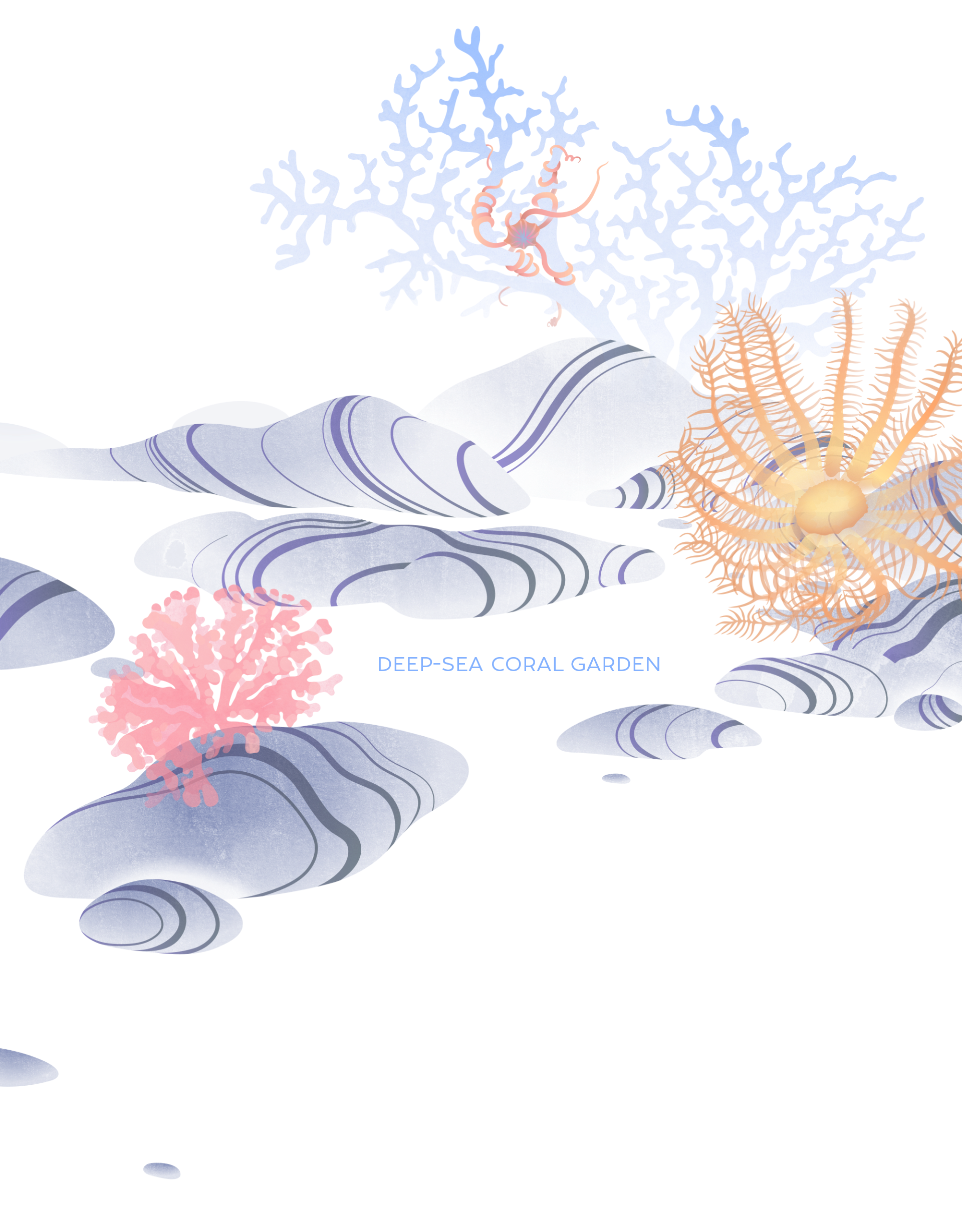
Deepwater coral garden
Depth: 3048m · Type: Depth milestone
Not all corals are tropical, shallow-water reef-builders! Many cold water corals are found in deep waters, where they provide habitat for other invertebrate species. Deep water corals are exceptionally slow growing.
Fire-breathing shrimp (Acanthephyra purpurea)
Depth: 3292m · Depth range: 300–3292m · Average length: 10 cm · Tags: Organism, Crustacean
A deep-sea shrimp that defends itself by ejecting a cloud of glowing bioluminescent fluid from its mouth, blinding predators while it escapes into the darkness — a marine analogue of a squid's ink cloud.
Source: WHOI HADES
Abyssal grenadier (Corpyphaenoides armatus)
Depth: 3350m · Depth range: 2000–4700m · Average length: 30 cm · Tags: Organism, Fish, Scavenger
One of the most abundant fish on the deep seafloor, the abyssal grenadier locates food by detecting faint chemical trails — homing in on dead carcasses that drift down from above. Its long, tapering tail and large head are typical of the rat-tail family.
Source: https://inaturalist.ca/taxa/194844-Coryphaenoides-armatus
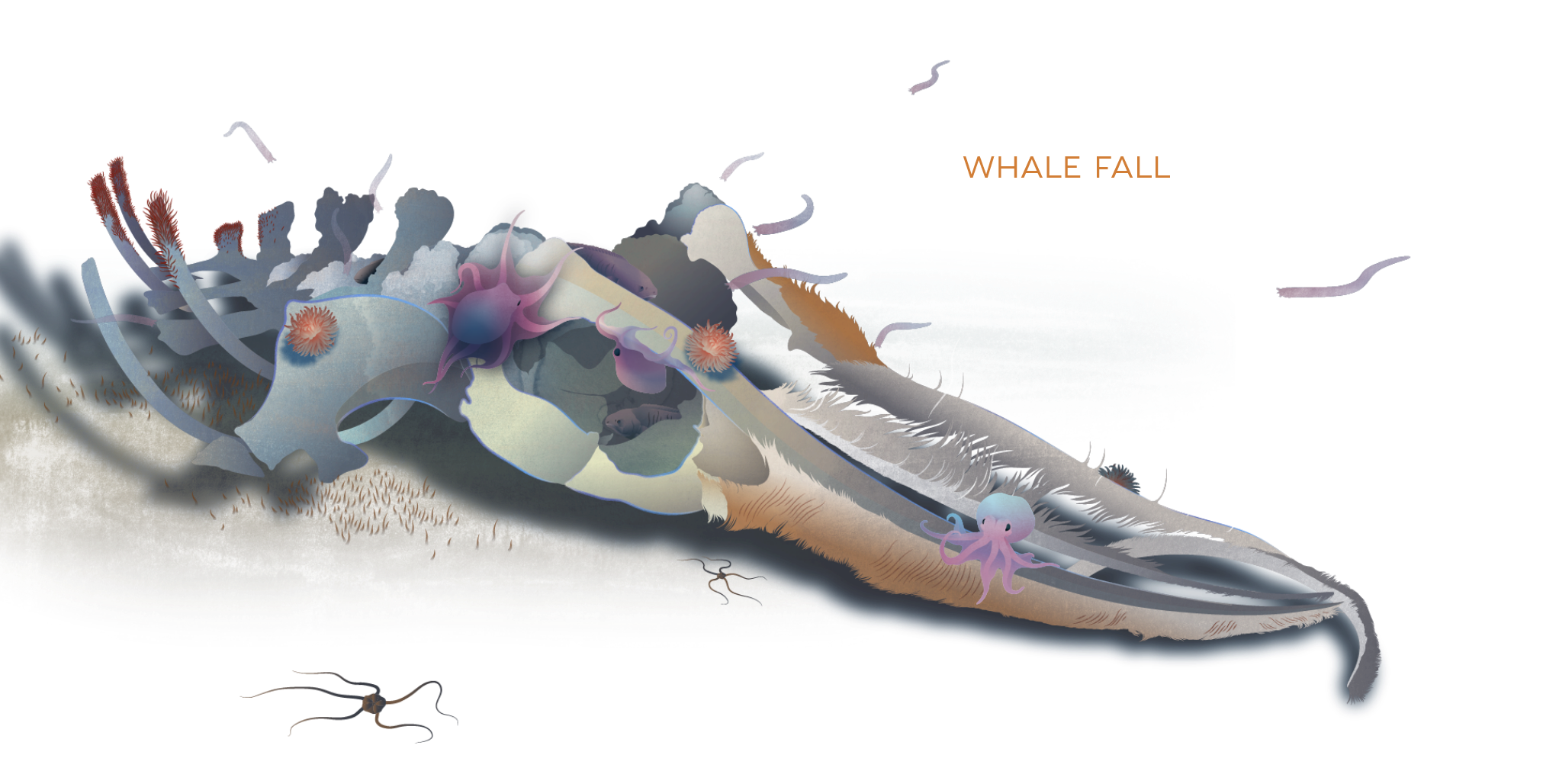
Whale carcasses provide a rare feast for deep sea scavengers.
Depth: 3375m
Green bomber worm (Swima bombiviridis)
Depth: 3510m · Depth range: 2700–3600m · Average length: 3 cm · Tags: Organism, Worm, Bioluminescent
A small swimming worm that defends itself by detaching glowing green "bombs" from its body — sacrificial sacs of bioluminescent fluid that flash brightly to distract predators while the worm slips away in the darkness.
Source: MBARI "Animals of the Deep"
Pearl octopus (Muusoctopus robustus)
Depth: 3900m · Depth range: 1200–3900m · Average length: 14 cm · Tags: Organism, Mollusk, Vent dweller
Gather at deep sea thermal springs, where the warm water is ideal for brooding their developing eggs. The largest of these is the Octopus Garden near the Davidson Seamount, the largest known aggregation of octopus on Earth.
Source: MBARI "Animals of the Deep"
Abyssal Zone (Abyssopelagic): 4000–6000m
The Abyssal Zone (abyssopelagic) covers 4,000 to 6,000 meters and includes most of the abyssal plains — the largest habitat on Earth. Pressure exceeds 400 atmospheres. Life is sparse, slow, and pressure-adapted: sea cucumbers, brittle stars, and microbial mats.
Welcome to the Abyssal Zone
Depth: 4000m · Type: Ocean zone callout
The abyss is defined by wide plains broken by trenches, seamounts, and oceanic ridges. It contains cold- and pressure-tolerant animals found nowhere else on earth.
Giant sea spider (Colossendeis spp.)
Depth: 4010m · Depth range: 2200–4000m · Average length: 51 cm · Tags: Organism
Found in all the world's oceans, it is the largest species of sea spider, growing larger than a dinner plate. It uses its sharp, tube-like proboscis to suck the guts out of soft bodied animals like anemones and sponges.
Source: MBARI "Animals of the Deep"
Slender snipe eel (Nemichthys scolopaceus)
Depth: 4025m · Depth range: 300–4000m · Average length: 1.5 m · Tags: Organism, Fish
They can get up to five feet long!
Source: MBARI "Animals A to Z"
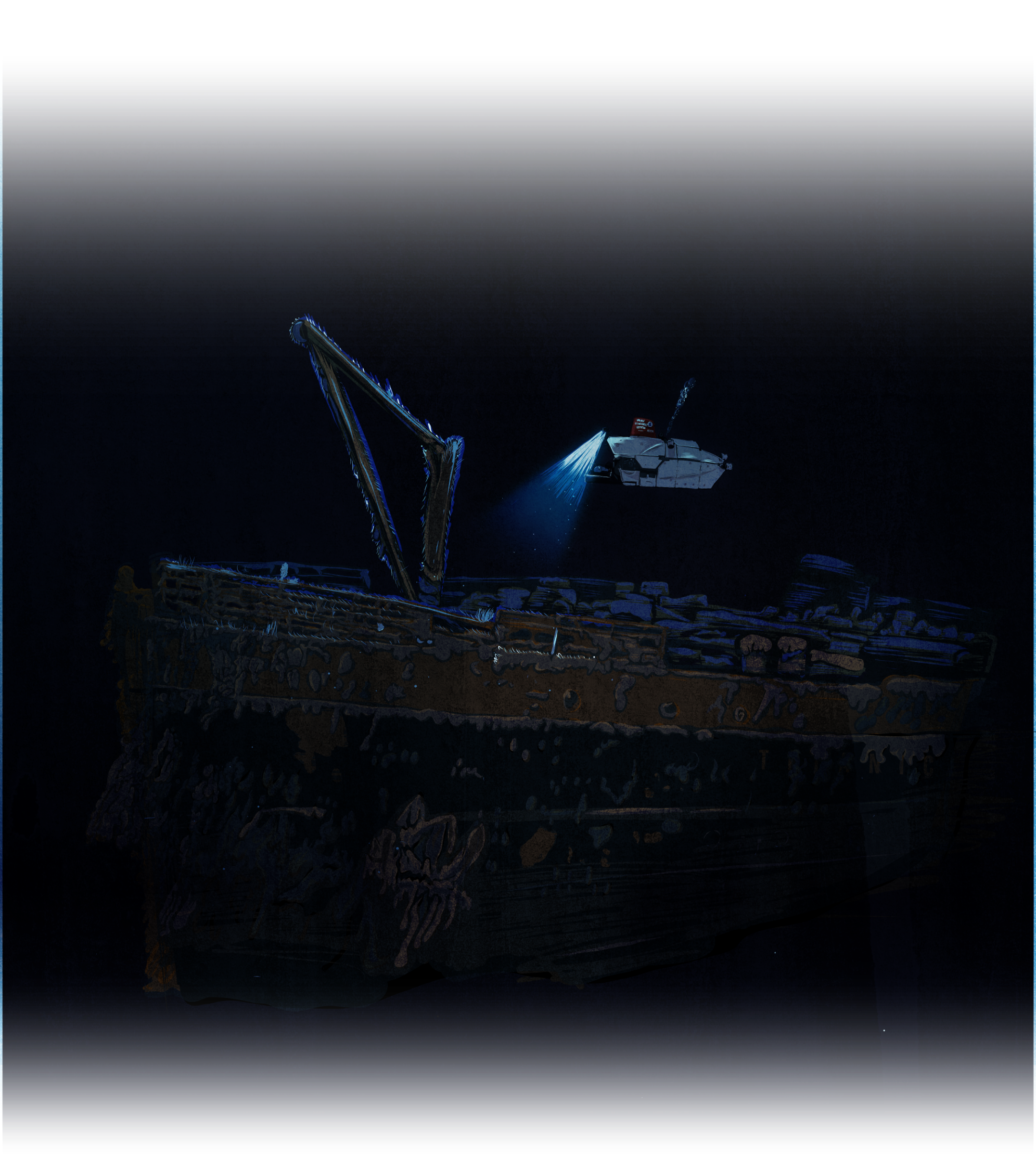
RMS Titanic
Depth: 4155m
Abyssal hermit crab (Parapagurus abyssorum)
Depth: 4360m · Depth range: 2500–4360m · Average length: 2 mm · Tags: Organism, Crustacean
A member of family Parapaguridae, which live at depths beyond 3600m. Instead of inhabiting empty snail shells like most hermit crabs, these will often carry around anemones, zoanthid corals, or even clam shells.
Source: Resultats des Campagnes Musorstom Vol. 20, French National Museum of Natural History
Dover sole (Microstomus pacificus)
Depth: 4500m · Depth range: 3–4500m · Average length: 45 cm · Tags: Organism, Fish
A long-lived North Pacific flatfish that can live more than 50 years. Both eyes migrate to the right side of its head as it grows, and the adult settles on the seafloor on its blind side. Fishermen nickname it the "slime sole" for the copious mucus it produces, and its larvae spend up to two years drifting in open water before settling to the bottom — the longest pelagic larval stage of any flatfish.
Source: https://www.fisheries.noaa.gov/species/dover-sole
Pressure equal to being stepped on by a male silverback gorilla in stilettos (6880 psi)
Depth: 4660m
Tripod fish (Bathypterois grallator)
Depth: 4695m · Depth range: 4000–4700m · Average length: 30 cm · Tags: Organism, Fish
Stands on three stilt-like fin rays that act as a tripod, propping it stationary on the soft seafloor. Facing into the current, it holds out two long pectoral fins to detect and snare tiny crustaceans drifting past — fishing with its body instead of swimming.
Source: https://www.marinespecies.org/aphia.php?p=taxdetails&id=126343
Abyssal coral-anemone (Corallimorpharia sp.)
Depth: 4879m · Depth range: 0–4879m · Average length: 5 cm · Tags: Organism, Cnidarian
Despite the common name, these abyssal cnidarians are corallimorpharians — close relatives of stony corals that lack a hard skeleton. Anchored to the deep seafloor, they capture drifting marine snow and small prey with their tentacles in one of Earth's most food-scarce habitats.
Source: https://oceanexplorer.noaa.gov/edu/learning/9_benthos/activities/benthic_animals.html
HROV <i>Nereid Under Ice</i>
Depth: 4970m · Depth range: 0–5000m · Tags: Vehicle, Tethered, Hadal-rated
A WHOI-built hybrid ROV designed to explore beneath ice shelves and floating sea ice, relaying video and data through a hair-thin 20 km fiber-optic microtether that it can release to continue the mission autonomously. Rated to 5,000 meters, NUI has operated from the Fram Strait pack ice to the calving front of Greenland's Kangerlussuup Sermia glacier.
Source: https://www.whoi.edu/what-we-do/explore/underwater-vehicles/hybrid-vehicles/nereid-under-ice/
REMUS 6000
Depth: 5045m · Depth range: 0–6000m · Average length: 3.84 m · Tags: Vehicle, Autonomous, Active
The largest member of the REMUS AUV family, developed jointly by WHOI, the Office of Naval Research, and the Naval Oceanographic Office. Rated to 6,000 meters with mission endurance up to 22 hours, REMUS 6000 carries out hydrographic surveys, debris-field mapping, and deep-ocean search and salvage missions where almost no other vehicle can reach.
Source: https://www2.whoi.edu/site/osl/vehicles/remus-6000/
Rattail fish (Coryphaenoides yaquinae)
Depth: 5180m · Depth range: 282-5180m · Average length: 50 cm · Tags: Organism, Fish, Scavenger
A Pacific-exclusive grenadier and the only member of its family known to enter the hadal zone — recorded at over 7,000 meters in the Mariana Trench. The rough abyssal grenadier is an active benthic forager, hunting squid, crustaceans, and polychaete worms on the deep seafloor while also scavenging whatever organic matter drifts down from above.
Source: https://en.wikipedia.org/wiki/Coryphaenoides_yaquinae
Abyssal prawn (Benthesicymus crenatus)
Depth: 5460m · Average length: 3 cm · Tags: Organism, Crustacean
Found via baited video lander deployed in the Kermadec Trench, Tonga Trench and the Japan Trench and in the Marianas region (NW Pacific).
Source: WHOI HADES
Molloy Hole
Depth: 5669m · Type: Depth milestone
Deepest point in the Arctic Ocean
Source: https://www.sciencedirect.com/science/article/pii/S001282521830429X
The first successful sampling of live amphipods occurred at this depth by Dr. Aristides Yayanos in 1977
Depth: 5700m
Umbellula coral (Umbellula sp.)
Depth: 5772m · Average length: 2 m · Tags: Organism, Cnidarian
A photograph of this soft coral was taken March 24, 2017 by NOAA Okeanos Explorer at Hadal Trough "Kinono," Phoenix Islands Protected Area (South Pacific).
Source: NOAA Benthic Deepwater Animal Identification Guide
Deepest clam (Calyptogena phaseoliformis)
Depth: 5990m · Depth range: 5100–6000m · Average length: 3 cm · Tags: Organism, Mollusk, Vent dweller
Often found at cold seeps, this clam obtains its food from methane-producing bacteria that live inside it. Discovered 1985 by the Nautile's series of dives in the Japan & Kurile Trenches.
Source: WHOI HADES
Hadal Zone (Hadopelagic): 6000–11100m
The Hadal Zone (hadopelagic) is the realm of the ocean trenches, from 6,000 meters to nearly 11,000 meters. Named after Hades, it is the least-explored habitat on Earth. The Challenger Deep in the Mariana Trench, at roughly 10,935 meters, is the deepest known point in the world ocean.
Welcome to the Hadal Zone
Depth: 6000m · Type: Ocean zone callout
Deep ocean trenches make up the entirety of the hadal zone, which is named for Hades, the Greek god of the underworld. This zone is characterized by extreme depth, pressure, and temperatures that hover just above freezing.
AUV <i>Sentry</i>
Depth: 6020m · Depth range: 0–6000m · Average length: 2.9 m · Tags: Vehicle, Autonomous, Hadal-rated
A WHOI-built autonomous mapping AUV rated to 6,000 meters and engineered to fly through extreme deep-sea terrain — including volcano calderas, mid-ocean ridges, and hydrothermal vent fields. Sentry produces high-resolution bathymetric, sidescan, sub-bottom, and magnetic maps of the seafloor and can be re-tasked acoustically from the surface mid-mission.
Source: https://ndsf.whoi.edu/sentry/
ROV <i>Jason</i>
Depth: 6350m · Depth range: 0–6500m · Average length: 3.4 m · Tags: Vehicle, Tethered, Active
A workhorse remotely operated vehicle built by WHOI's Deep Submergence Laboratory, flown from the ship through a 10-kilometer reinforced fiber-optic cable that delivers power, commands, and live video in real time. Now in its third generation, Jason has made hundreds of dives to hydrothermal vents in the Pacific, Atlantic, and Indian Oceans.
Source: https://ndsf.whoi.edu/jason/
DSV <i>Alvin</i>
Depth: 6500m · Depth range: 0–6500m · Average length: 7 m · Tags: Vehicle, Manned, Historic, Active
The most storied research submersible in the world, carrying a pilot and two scientists inside its titanium personnel sphere for dives of up to 12 hours. Following a major 2020–2022 overhaul, Alvin can now reach 6,500 meters — putting roughly 99% of the global seafloor within reach of in-person scientific study.
Source: https://ndsf.whoi.edu/alvin/
Congrats! You've explored 99% of the Seafloor!
Depth: 6525m
Owlfish (Pseudobathylagus milleri)
Depth: 6600m · Depth range: 250–6600m · Average length: 17 cm · Tags: Organism, Fish
It gets its name from its huge eyes that are adapted to capture as much light as possible.
Source: iNaturalist
Pressure required to operate Jaws of Life rescue equipment (10,000 psi)
Depth: 6800m
Dumbo octopus (Grimpoteuthis sp.)
Depth: 6920m · Depth range: 1000–6957m · Average length: 20 cm · Tags: Organism, Mollusk
This deepest-known group of octopuses are named for the large ear-like fins that they swim with.
Source: https://inaturalist.ca/taxa/82228-Grimpoteuthis
Headless Chicken Monster (Enypniastes sp.)
Depth: 7030m · Depth range: 500–7000m · Average length: 25 cm · Tags: Organism, Echinoderm
Due to its odd appearance, this genus of swimming sea cucumbers has been called many different names:. "the headless chicken monster," "the spanish dancer," "the pink see-through fantasia," and others. They mainly eat detritus off the sea floor, but will swim as much as 1000m up into the water column to search for new feeding grounds.
Source: SeaLifeBase (https://www.sealifebase.se/search.php)
Java Trench
Depth: 7187m · Type: Depth milestone
Deepest point in the Indian Ocean
Source: https://www.sciencedirect.com/science/article/pii/S001282521830429X
Supergiant amphipod (Alicella gigantea)
Depth: 7230m · Depth range: 4000m+ · Average length: 34 cm · Tags: Organism, Crustacean, Scavenger
A staggering example of "abyssal gigantism" — this scavenging amphipod reaches more than 30 cm long, far larger than its centimeter-scale shallow-water relatives. It descends on baited traps in the deep ocean to feed on whale falls and other carrion.
Source: https://inaturalist.ca/taxa/425121-Alicella-gigantea
South Sandwich Trench
Depth: 7432m · Type: Depth milestone
Deepest point in the Southern Ocean
Source: https://www.sciencedirect.com/science/article/pii/S001282521830429X
Scavenging amphipod (Eurythenes gryllus)
Depth: 7800m · Depth range: 550–7800m · Average length: 15 cm · Tags: Organism, Crustacean, Scavenger
Collected by Dr. Alan Jamieson from the Peru-Chile Trench. A fast swimmer with an incredible ability to sniff out food at distance, this species is one of the fastest to arrive at bait traps.
Source: WHOI HADES
Eyes and pigment aren't necessary down here due to scarcity of light
Depth: 7840m
Dulcinea amphipod (Dulcinea camanchaca)
Depth: 7910m · Average length: 4 cm · Tags: Organism, Crustacean, Hadal, Predator
A fast-swimming predator originating from Atacama Trench off the coast of Peru and Chile. Its genus name, "Dulcinea," is a character from Miguel de Cervantes's novel Don Quixote, and its species name "camanchaca" means "darkness" or "mist" in Quechua, a language indigenous to the Andes region.
Source: OCEANUS: "Deep-sea amphipod name inspired by literary masterpiece"
Modern oceanography began with the HMS Challenger Expedition between 1872 and 1976.
Depth: 8100m
It was the first expedition organized specifically to gather data on a wide range of ocean features.
Depth: 8150m
Using a thick cord of hemp rope, they were able to measure an 8200 meter section of the Mariana Trench, which we now know is the deepest region in all the world's oceans.
Depth: 8200m
Mariana snailfish (Pseudoliparis swirei)
Depth: 8336m · Depth range: 6198–8336m · Average length: 29 cm · Tags: Organism, Fish, Hadal
Holds the record for the deepest-living fish ever filmed, observed past 8,000 meters. Its gelatinous, scale-less body and partially open skull are evolutionary solutions to surviving pressures over 800 times that at sea level.
Source: https://oceanexplorer.noaa.gov/ocean-fact/what-is-the-deepest-living-fish/
Abyssobrotula galathea (Abyssobrotula galathea)
Depth: 8375m
1977 record deepest fish 8370m
Beyond this point, it's believed that ambient pressures are too great for any fish to survive.
Depth: 8500m
Could we have been the first vertebrate to make it this far?
Depth: 8570m
Puerto Rico Trench
Depth: 8605m · Type: Depth milestone
Deepest point in the Atlantic Ocean
Source: https://www.sciencedirect.com/science/article/pii/S001282521830429X
If Mt. Everest was upside down
Depth: 8848.9m · Type: Depth milestone
Prince Axel's amphipod (Princaxelia jamiesoni)
Depth: 9330m · Depth range: 7703–9316m · Average length: 6 cm · Tags: Organism, Crustacean, Hadal
Filmed and caught by Dr. Alan Jamieson on HADEEP research cruise at Japan Trench in 2008, then at Izu-Bonin Trench in 2009. The genus Princaxelia was named for Prince Axel of Denmark in 1959 when Danish Galathea expeditions discovered this kind of shrimp.
Source: WHOI HADES
Under these pressures, the exoskeletons of crabs and amphipods can disintegrate like paper.
Depth: 9480m
This amphipod protects itself by eating aluminum-rich sediment, which it secretes in a metallic casing over its body.
Depth: 9530m
Forams (Foraminifera)
Depth: 9807m · Average length: 0.5 mm · Tags: Organism, Microbe
Found in a grab sample on the floor of the Philippine Trench by R. R. Hessler (Scripps) during research cruise on the research vessel Washington. Also common in benthic sediments everywhere; some are also planktonic.
Source: WHOI HADES
Sea pig (Scotoplanes globosa)
Depth: 9860m · Depth range: 1000–9997m · Average length: 2 cm · Tags: Organism, Echinoderm, Scavenger
One of the deepest-living sea cucumbers, it uses the ring of tentacles around its mouth to snuffle around in the mud for food. Sometimes, juvenile king crabs will hitch a ride on their bellies.
Source: https://inaturalist.ca/taxa/568142-Scotoplanes-globosa
Gelatinous animals, like this sea pig, maintain their shape via a fluid-filled cavity called a “hydrostatic skeleton.”
Depth: 9870m
Think of it like a stiff, pressurized water balloon in the center of your body, providing something for your muscles to push against.
Depth: 9890m
This structure affords them the flexibility to withstand even the most extreme pressures of the deep sea.
Depth: 9940m
We used to think life couldn't exist at these depths, but in 1951, the Danish vessel Galathea returned with the first-ever biological sample from the bottom of the Philippine Trench.
Depth: 10120m
Bathyscape Trieste
Depth: 10525m · Depth range: 0–10937m · Average length: 23.8 m · Tags: Vehicle, Manned, Historic, Retired
On January 23, 1960, the Bathyscaphe was first crewed vessel to ever reach the Challenger Deep. It was designed by Swiss scientist Auguste Piccard, whose son, Jaques Piccard, piloted its historical descent alongside American oceanographer Don Walsh. In 1984, it was deactivated and is now on display at the National Museum of the US Navy in Washington D.C.
Source: https://www.bathyscaphtrieste.org/
In 1960, the Trieste and her crew were the first manned vessel to reach the deepest depths of the ocean.
Depth: 10580m
Horizon Deep
Depth: 10825m · Type: Depth milestone
2nd deepest point on Earth
Barophillic bacteria
Depth: 10860m · Depth range: 10898m · Tags: Organism, Biology
Obligately barophilic, meaning it can only survive under extreme pressure. Discovered by ROV Kaiko in the Mariana Trench, Challenger Deep.
Source: https://ndsf.whoi.edu/alvin/specifications/
<i>Deep Venture</i>
Depth: 10870m · Depth range: 0–11000m · Average length: 1.7 m · Tags: Vehicle, Autonomous, Full-ocean depth
A WHOI-built hadal AUV designed as part of a networked fleet of small, modular trench explorers — even repurposing leftover syntactic foam from James Cameron's Deepsea Challenger submersible. Rated to 11,000 meters, Deep Venture uses visual terrain-relative navigation to land softly on the seafloor and sample without disturbing the environment.
Source: https://www.whoi.edu/what-we-do/explore/underwater-vehicles/auvs/orpheus/
Only 27 humans have reached this depth, but our impact has.
Depth: 10885m
Welcome to the Challenger Deep!
Depth: 10900m · Type: Depth milestone
The deepest point of the ocean, named after the HMS Challenger Earth's first oceanographic research mission
This amphipod was named after the plastic piece found in its gut contents.
Depth: 10915m
Plastic-eating amphipod (Eurythenes plasticus)
Depth: 10932m · Depth range: 0–11000m · Average length: 3 cm · Tags: Organism, Crustacean, Hadal
A scavenging amphipod discovered in the Mariana Trench in 2020, named after the microplastic fragments found in its gut at the time of its description. Its scientific name was deliberately chosen to highlight that human plastic pollution has now reached even the deepest places on Earth.
Source: https://inaturalist.ca/taxa/1044372-Eurythenes-plasticus
Biogenous ooze
Depth: 10960m