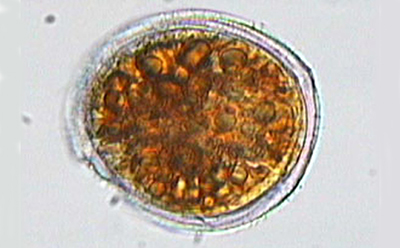
Pfiesteria piscicida zoospores shown swarming around (short arrows), penetrating, and consuming (long arrows) a live eastern oyster larva. (J. Burkholder)
Economic Impacts
A preliminary and highly conservative nationwide estimate of the
average annual costs of HABs is approximately $50 million. Public
health is the largest component, representing nearly $20 million
annually, or about 42% of the nationwide average cost. The effect on
commercial fisheries averages $18 million annually, followed by $7
million for recreation and tourism effects, and $2 million for
monitoring and management. The actual dollar amount of these estimates
is highly uncertain due to a lack of information about the overall
effect of many HAB events and a difficulty in assigning a dollar cost
to those events that we do understand. While many expenses may be
difficult to quantify, there is little doubt that the economic effects
of specific HAB events can be serious at local and regional levels.
Separate
from the national average, massive losses from isolated, individual
events underscore the severity of the problem. A recent PSP event in
New England caused estimated losses of $12 to $20 million in
Massachusetts alone, with additional losses in New Hampshire and
Maine. Continual PSP intoxication in Alaskan shellfish is one factor
blamed for the lack of development of a commercial, wild shellfish
industry, estimated to be worth $6 million annually. Blooms of one of
the brown tide organisms, Aureococcus anophagefferens, devastated the bay scallop industry in Long Island, estimated to be worth $2 million annually. Outbreaks of Pfiesteria-like
organisms in 1997 in Chesapeake Bay tributaries resulted in a collapse
of seafood sales and boat charters, with losses to watermen, seafood
dealers, and seafood restaurants approximating $43 million.
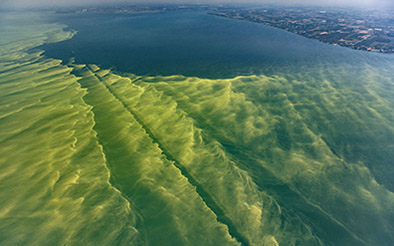
Cyanobacterial harmful algal blooms (CyanoHABs) can have significant economic and sociocultural impacts due to the human health threats and their negative impact on aquaculture, recreation, and tourism. Unfortunately, these impacts have not been well quantified and documented in the U.S. As an example of the potential magnitude of economic losses, overall costs in Australia have been estimated between A$180 million and A$240 million per year, which would be equivalent to about $150-200 million in U.S. 2002 dollars.
In the U.S., toxins and taste-and-odor compounds (geosmin and 2-methylisoborneaol, or MIB) result in increased treatment costs for drinking water facilities and algal mats can interfere with reservoir operations such as drinking water intakes and hydroelectric generation. Closures of recreational water-bodies to protect human health can result in revenue losses for local communities, especially during holiday weekends or planned events.
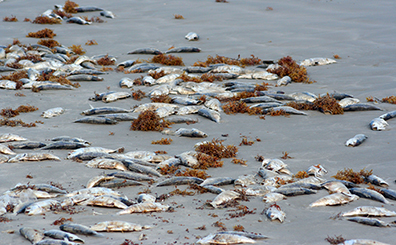
The economics of HAB outbreaks are extremely hard to quantify accurately. The financial impacts of HABs range from loss of marketable product, costs of maintaining measures necessary to monitor, mitigate, and manage events, and human health impairment, which translates to medical costs and lost wages and earnings. During the 1997 outbreak of fish kills in Maryland, which were associated with the dinoflagellate Pfiesteria piscicida, it was estimated that the direct cost was at least $43 million dollars, based solely on the decline in seafood sales. When losses to tourism, recreational fisheries, and increased costs of monitoring and analysis are factored in, the economic impacts of this event were staggering. Furthermore, despite the use of educational materials indicating that waters were subsequently safe, consumers were very slow to resume consumption of the impacted product leading to prolonged losses to the seafood community.
Last updated: July 31, 2012

© Copyright WHOI 2007. All rights reserved.