
Terrence Joyce, Clara Deser and Michael Spall
Introduction
In this report, we study the decadal variability of Subtropical Mode Water (STMW) in the N. Atlantic, refered to as is the 18 degree C water (Worthington, 1959) and found to the south of the Gulf Stream in the Sargasso Sea. It is formed annually during late winter in a region that has some of the largest heat losses in the World Ocean. However, every winter is not the same and there is a large variation in the properties of this mode water on a year to year basis. Talley and Raymer (1982), recently updated by Talley (1996), noted some key average characteristics (Talley, 1996, Table 2): mean depth = 287m, mean potential density = 26.45 kg/m3, and mean potential temperature and salinity of 17.88o C and 36.5 psu, respectively. Joyce and Robbins (1996) noted that the variability of the potential vorticity, PV= - (f / r) rz, at 300m depth (near mean depth of STMW at Bermuda) was anti-correlated with surface density changes. Thinking of purely diabatic processes for the formation of the STMW, one would have to make the near surface density larger in order to convectively mix the STMW, consistent with observations. We expand on this theme in this study, first using the PV variability of the STMW from Joyce and Robbins and comparing this to decadal variations in the wintertime buoyancy flux at the surface and then to other atmospheric fields, including sea level pressure (SLP), which will inevitably invoke a NAO-type pattern. A revised North Atlantic Oscillation (NAO) index, keyed to the correlation with the PV signal will then be obtained. Finally, we will explore the nature of the atmospheric and oceanic signal in different NAO/STMW 'epochs', concluding with comments on why the two signals are phased as they are with some speculation on a possible coupling mechanism.
Bermuda reference time series
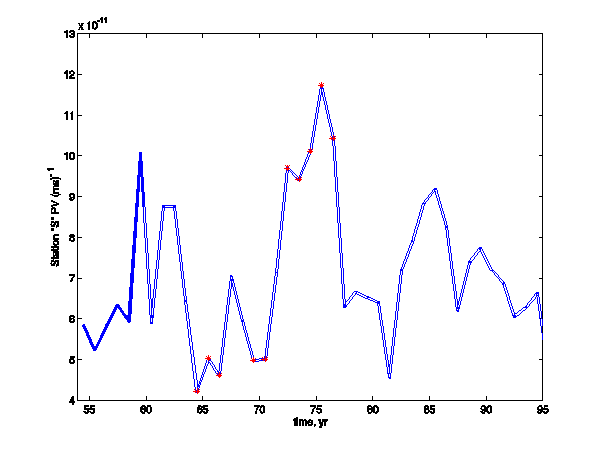
The Bermuda time series of PV is ideally situated within the pool of the STMW as shown by the Lozier et al (1995) analysis of PV on the 26.5 potential density surface. Thus, effects of lateral shifts in the low PV pool are minimized at Bermuda and changes may be thought of as arising from either vertical motion (stretching, squashing) of the water column or diabatic forcing. As interannual variability of the PV at depths of the STMW is uncorrelated with temperature & salinity variability of the main pycnocline, we conclude that interannual variability arises from diabatic processes. In order to examine this hypothesis, we have used the da Silva et al (1994) atlas of COADS starting from the beginning of the station "S" time series at Bermuda and ending with the final year analyzed by da Silva et al: 1989. The PV time series (Fig1) shows decadal variations of over a factor of 2 in the PV (or equivalently, the thickness or vertical extent of the STMW). This signal clearly shows decadal type variations, with a climatological minimum value in 1964 and a maximum in 1975. We will later focus on these two extreme time periods in order to better characterize the surface forcing.). We have indicated the 5 lowest and highest years in the Bermuda record (symbols in Fig1).
Atmospheric forcing
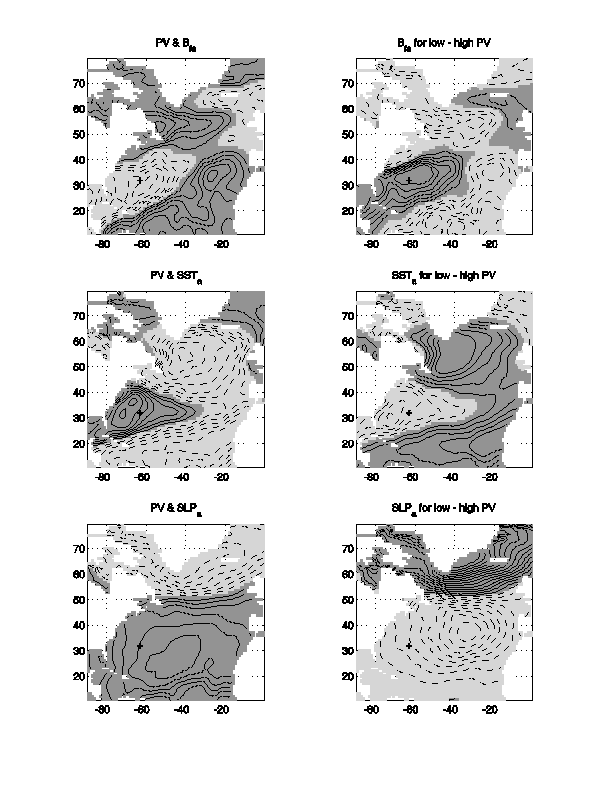
We have correlated the time series with the meteorlogical forcing (Fig2, positive contours solid & shaded dark grey, negative dashed & shaded light grey) using buoyancy flux, which is so defined that a positive flux or interannual anomaly will make the ocean surface denser. Thus, the Bermuda PV signal should be anticorrelated with this since denser water makes for more wintertime convection, thicker mode water and lower PV. We have used only the winter months (Jan-Mar) in the forcing and as expected (Fig2, upper left), the whole western region of the subtropical gyre is anticorrelated with the buoyancy flux. We show also the contrast between the buoyancy flux during the 5 low minus the five high PV years (fig2, upper right) where the contour interval is 0.5 x 10⁻⁵ kg(ms3)-1. Note that when the PV is low (high) at Bermuda, the buoyancy forcing is high (low) over the western subtropical gyre, but has opposite sign over the tropics, eastern subtropical gyre and the subpolar region. We show the SST and SLP anomalies for the low-high PV years (Fig. 2, middle and lower right panels) and remark that the SST (middle right, contour interval 0.2 oC) is anomalously cool throughout the western subtropical gyre with an amplitude of about –0.8o C. Comparing the low-high PV years, atmospheric pressure (lower right, contour interval 1 mbar) is lower near the Azores and higher between Greenland and Iceland by about 10 mbar. We have not shown the net heat flux, but it behaves very much like net buoyancy flux, but with a different sign. The low-high PV composite pattern for SLP is very similar to Hurrell's (1995.) NAO pattern, except that the subtropical Atlantic center is shifted about 30 degrees further west and about 5 degrees further south. Using the SLP regression against PV, we constructed an NAO index, defined as the normalized SLP in the Icelandic area minus that in the subtropics. The correlation between the smoothed (with a 3-pt binomial filter in time) NAO and PV is nearly 0.8 up through 1990, but is reduced if the later years are included owing to the increase in NAO index in recent years with little change in the STMW PV. This will be shown in the next section. The effect of the NAO forcing on the SST field that is implicitly taken to account for the STMW/SST correlation (Fig3, middle panels) in the Sargasso Sea could well be that of the ocean's passive response to atmospheric forcing as pointed out by Cayan (1992) and Molinari et al (1997). However, temperature changes near the axis of the Gulf Stream can be induced by north/south shifts in the axis of the separated western boundary current. We will turn next to this phenomenon.
Decadal variations in the latitude of the separated Gulf Stream
In order to further investigate the issue of interannual changes in Gulf Stream position, we have used subsurface temperature data from the Levitus (1994) atlas of MBT and XBT data for the common time period of 1954-1989. The temperature at 200m depth has been used for some time as defining the region of strong flow of the Gulf Stream (Fuglister, 1955). The 15oC isotherm at 200m , representing an isotherm in the center of the strong horizontal gradient of the Gulf Stream, lies just to the north of the maximum flow at the surface (Fuglister, 1960) and is a convenient marker for the northern 'wall' of the stream. This has been confirmed by the time series of Halkin and Rossby (1985) near 73W in which temperature and velocity profiles were placed in a stream-oriented coordinate system and averaged.
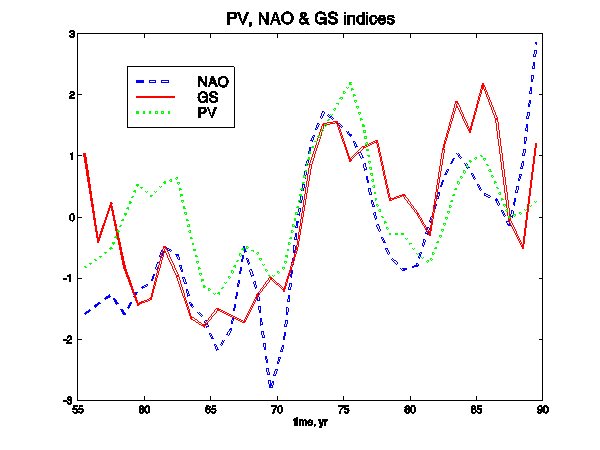
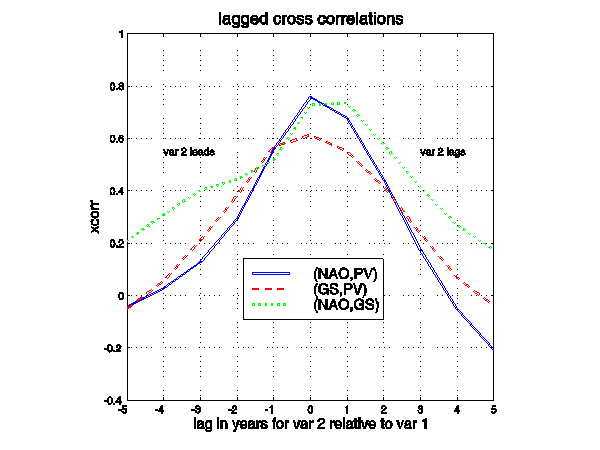
Taylor and Stephens (1998) develop further the idea that coordinated north/south shifts in the Gulf Stream on interannual time scales are correlated with the NAO. In order to better compare our results with theirs, we have selected 7 locations along the Gulf Stream path between 75 and 60o W and used an EOF analysis of the T(200m) data to determine an index for the Gulf Stream position. Based on the yearly averages, the most energetic mode (more than 50% of variance) represents an in phase north/south shift in position that is correlated (r=0.7) with our NAO index (Fig3) with maximum correlation at lags of both 0 and 1 year for the GS following the NAO (Fig4). We note that this differs from the result in Taylor and Stephens (1998), who used a different NAO index and a Gulf Stream index based on monthly frontal analyses of satellite imagery. They found a maximum correlation when the GS index lagged the NAO by 2 years. There is some suggestion (Fig.4) that a time lag might exist for our GS/NAO cross-correlation, but it is of about 1 year and, as we noted above, the two signals are highly correlated at zero lag. We have compared our index with theirs (which captures about 25% of the variance in their data set) and can see that the two agree in recent years but disagree prior to 1970. We attribute this difference to the increasing skill in the frontal analysis product over time. With the GS position essentially in phase or lagging by at most 1 year the NAO, our interpretation is quite different from theirs: we do not see the NAO as forcing a delayed, baroclinic response in the GS position, but that the two co-vary together, although there is a some suggestion that part of the GS signal may be delayed by at most a year. We also show the time variation of the STMW signal in PV, which is highly correlated with both the GS path and the NAO.
Summary
A manuscript summarizing these results (Joyce, Deser and Spall, 2000) also discusses variations in mid-latitude cyclones in concert with changes in STMW and presents a feedback mechanism that could create a causal link among the types of correlated variability presented. The latter arises because periods of low PV in the Sargasso Sea are anti-correlated with those in the subpolar gyre/Labrador Sea as discussed by Dickson et al (1997), and time-dependant export of the anomalous Labrador Sea Water within the Deep western Boundary Current (DWBC) can influence the separation latitude of the Gulf Stream once that signal propagates from the source region to the crossover point of the two flows. Here we only briefly summarize the findings of our work as a list of major results:
Cayan, D. R., 1992, Latent and sensible heat flux anomalies over the northern oceans: driving the sea surface temperature. J. Phys. Oceanogr., 22, 859-881.
da Silva, A. M. and S. Levitus, 1994, Atlas of marine data 1994, volume 1: algorithms and procedures. US Dept. of Commerce, December 1994, 83pp.
Dickson, R., J. Lazier, J. Meinke, P. Rhines and J. Swift, 1996. Long-term coordinated changes in the convective activity of the North Atlantic, Prog. Oceanogr., 38, 241-295.
Fuglister, F. C., 1955, Alternate analyses of current surveys. Deep-Sea Res., 2, 213-229.
Fuglister, F. C., 1963, Gulf Stream '60. Prog. in Oceanogr., 1, 265-373.
Halliwell, G. R. Jr. and C. N. K. Mooers, 1979, The space-time structure and variability of the Shelf Water-Slope Water and Gulf Stream surface temperature fronts and associated warm-core eddies. J. Geophys. Res., 84, 7707-7725.
Halkin, D. and T. Rossby, 1985, The structure and transport of the Gulf Stream at 73W. J. Phys. Oceanogr., 15, 1439-1452.
Hurrell, J. W., 1995, Decadal trends in the North Atlantic Oscillation: regional temperatures and precipitation. Science, 269, 676-679.
Joyce, T. M. and P. E. Robbins, 1996, The long-term hydrographic record at Bermuda. J. Climate, 9, 3121-3131.
Joyce, T. M., C. Deser, and M. A. Spall, 2000, The relation between decadal variability of subtropical mode water and the North Atlantic Oscillation. J. Climate, 13, 2550-2569.
Levitus, S., 1994, World ocean atlas 1994 CD-Rom sets. National Oceanographic Data Center Informal report, 13.
Lozier, M. S., W. B. Owens and R. G. Curry, 1995, The climatology of the North Atlantic. Prog. Oceanogr., 36, 1-44.
Molinari, R. L., D. A. Mayer, J. F. Festa and H. F. Bezdek, 1997, Multiyear variability in the near-surface temperature structure of the midlatitide western North Atlantic Ocean. J. Geophys. Res., 102, 3267-3278.
Talley, L. D. and M. E. Raymer, 1982, Eighteen degree Water variability, J. Marine Res., 40, 757-775.
Talley, L. E., 1996, north Atlantic circulation and variability, reviwed for the CNLS conference. Physica D, 98, 625-646.
Taylor, A. H. and J. A. Stephens, 1998, The North Atlantic oscillation and the latitude of the Gulf Stream, Tellus (50A), 134-142.