Overview
Estuarine
and Coastal Processes
Fisheries
and Aquaculture
Environmental
Technology
Marine
Biotechnology
Marine
Policy
Public Outreach,
Education, and Extension Projects
- Communications/Education
- Coastal Processes Extension
- Fisheries and Aquaculture Extension
|
Outreach, Education and Human Resources
(Click here to view
this document as a PDF file.)
Snapshot
WHOI Sea Grant's investment in Outreach, Education, and Human Resources
has resulted in the development and implementation of educational
materials and programs designed to encourage users of our marine
and coastal resources to explore, understand, and appreciate the
value of these resources.
Background
Since the establishment of a marine assistance program in 1979 --
the precursor to the program's marine advisory service (1990) and
the marine extension service (1998) -- and a formal communications
program in 1990, WHOI Sea Grant has been regarded as an important
source of marine-related information. Locally, nationally, and internationally,
WHOI Sea Grant provides information about the marine environment
to students, educators, coastal residents and tourists, coastal
decision-makers and elected officials, individuals whose livelihood
is derived from the sea, and the public at large. In so doing, our
outreach staff, often in partnership with other coastal organizations,
serve as conduits, gathering the information and research needs
of these groups and bringing it back to the program management team,
advisory board, and to funding sources so that these needs can be
met. Establishing these lines of communication has helped the program
develop its focus areas and best serve its constituencies.
At WHOI Sea Grant, outreach and education activities
figure prominently in the program's management. By reaching out
to audiences in an attempt to answer questions, increase environmental
awareness, improve science literacy, and bridge the gap between
marine research and an informed and knowledgeable public, the Sea
Grant outreach effort is making significant contributions to citizens
and organizations within the region and, in many cases, throughout
the nation.
Objectives
WHOI Sea Grant's theme in Outreach, Education, and Human Resources
provides a mechanism by which research results and the excitement
of scientific discovery can be shared with diverse audiences. Within
the framework of the NOAA Sea Grant Strategic Plan, 1995-2005, WHOI
Sea Grant efforts are focused on three major portfolios: Economic
Leadership, Coastal Ecosystem Health and Public Safety, and Education
and Human Resources. Within these portfolios there are major strategic
initiatives in advanced technology for commercial products, seafood
production, coastal economic development, coastal ecosystem processes,
public safety, technology transfer, and public outreach. To fulfill
our objectives and mandate within the strategic plan, WHOI Sea Grant's
theme in Outreach, Education, and Human Resources has focused on:
- Identifying and implementing effective outreach tools to target
specific audiences. Such tools include workshops, publications,
public exhibits and posters, lectures, media contacts, special
events, radio programming, materials for educators, and the Internet.
- Building successful partnerships with organizations whose mission
or objectives are similar to those of WHOI Sea Grant or whose
activities impact the marine and/or coastal environment. These
partnerships are designed to enhance our ability to create an
informed and knowledgeable public.
- Creation of a marine outreach guidance group (MOGG), comprised
of representatives of the region's public, private, and governmental
organizations involved in coastal and marine issues, to advise
the staff on its outreach activities and, to some degree, its
research program.
Sea Grant Involvement
Since 1990 the WHOI Sea Grant program has worked to disseminate
the latest oceanographic and coastal marine scientific discoveries
to a variety of audiences. Our efforts are focused on delivering
the most up-to-date and relevant information available to our audiences,
based on their needs and interest areas.
Recognizing the importance of the Internet as a
communications tool, we have invested considerable time and resources
to maintaining a timely, informative, and easy-to-navigate web presence,
www.whoi.edu/seagrant. Publications also remain an important and
effective communications tool. For the most part, we limit our publications
to concise descriptions of current research, written for a lay audience,
and publish these descriptions in the following formats: newsletter
(Two if by Sea, three times per year, jointly published with MIT
Sea Grant), fact sheets (Focal Points, targeted at legislators and
coastal decision-makers, and Marine Extension Bulletins, aimed at
a technically trained audience), news releases, and program guides
(published biennially, coincident with out funding cycle). More
descriptive publications are generally reserved for our technical
and/or special interest audiences, and include technical reports
and workshop proceedings.
Clearly, outreach is very effective through direct
contact, so WHOI Sea Grant staff members maintain memberships on
various boards, committees, and
organizations, and spend as much time in the field
and interacting with our user groups as possible.
Equally as important as disseminating information is staying current
on the latest technologies and methodologies that relate to staff
areas of expertise. This is accomplished through professional development
opportunities and training sessions for all staff members.
Producing Significant Results
Education
A sampling of our accomplishments, 1990-2000:
- Sponsorship of staff training and development workshops for
formal (pre-K-grade 12) and informal educators on various topics
- Creation and dissemination of the WHOI Teacher Packet
- Sponsorship of a teacher fellow as part of WHOI's 1998-99 Summer
Teacher Fellow Program
- Sponsorship of summer outreach interns, as available
- Active membership in the Woods Hole Science and Technology
Education Partnership (WHSTEP), a partnership between local science
and technology-related businesses, schools, and the scientific
institutions in the Upper Cape region
- Involvement with the WHOI-Turnstone Publishing venture to offer
supplemental curriculum materials on oceanography for classroom
use. Two series of four books each are now available through Steck-Vaughn
publishers: Ocean Pilot, geared for grades 4-6 and Ocean Explorer,
for grades 6-8
- Sponsorship of annual summer "Sea Urchins" program
for children ages 5-7, to introduce young students to the wonder
and value of seashore life
- Participation (annually since 1990) in the conferences of the
Massachusetts Marine Educators, the 1996, 1998, 1999, 2000 annual
conferences of the National Marine Educators Association, and
the 1999 National Science Teachers Association conference
- Co-investigator (with New Hampshire Sea Grant) for national
Sea Grant marine science careers-related projects: Marine Science
Careers: A Sea Grant Guide to Ocean Opportunities (first published
in 1996, revised edition in 2000), and a related web site http://www.marinecareers.net,
which debuted in late June 1999.
Public Outreach
A sampling of our accomplishments, 1990-2000:
- Sponsorship of annual Coastweeks events
- Dissemination of publications, videotapes, audiocassettes,
or other printed materials as published in refereed publications
and grey literature
- "Oceans Alive" annual public lecture series
- Sponsorship of the summer "Sea Urchins" program for
children ages 5-7
- Maintenance of a WHOI Sea Grant exhibit at the WHOI Visitor
Center, which includes current research and outreach projects.
Annual attendance at the center is 30,000
- Participation in the 1998 Year of the Ocean celebration, Sea
Grant's 30th Anniversary celebration, and annual participation
in the National Ocean Science Bowl
- Sponsorship of an open house for policy-makers, regulators,
legislators, and other local officials (1995 and 1998
- "SoundWaves" Low Power Radio Project, a cooperative
project between WHOI Sea Grant, Cape and Islands Community Public
Radio (CICPR), and the Woods Hole--Martha's Vineyard Steamship
Authority. The 33-minute repeating loop broadcasts on 1620 AM
and provides information about Woods Hole for ferry passengers
with auto reservations -- representing a potential audience of
well over one million each year
- Publications, including Two if by Sea newsletter, Nor'easter
magazine, the WHOI Sea Grant web site (http://www.whoi.edu/seagrant),
and the Northeast Regional Sea Grant web site)
Extension Support
WHOI Sea Grant Focal
Points, fact sheets for legislators and coastal decision-makers:
- Research Update: Contaminants in the Marine Environment and
Their Effects on Marine Mammals
- The Massachusetts Bay Outfall
- Endocrine Disruption in Wildlife Population
- Harmful Algal Blooms (HABs) in the United States
- New Tools for Assessing Water Quality: Stable Isotope Analysis
of Nutrient
- Shellfish Diseases and their Controls in Local Waters
- Shellfish Aquaculture in Massachusetts
- Shellfish Resource Management in Massachusetts
WHOI Sea Grant Marine
Extension Bulletins, technical fact sheets for regional industry,
agencies, and professional organizations:
- Federal Crop Insurance for Massachusetts Quahog Farmers
- Clam Tents: A New Approach to Soft-shell Clam Culture and Management
- Perigean Spring Tides (Predicting Potential Disasters: How
Tidal Information May Save You from a Coastal Crisis)
WHOI Technical Reports:
- Coastal Landform Management in Massachusetts: Proceedings of
a Workshop held at the Woods Hole Oceanographic Institution, Woods
Hole, MA, USA, October 9-10, 1997
- Coastal Landform Sustainability Project: An Analysis of Activities
Permitted on Coastal Landforms on Cape Cod, Massachusetts in 1999
Directory of Cape and Islands Coastal Outreach
Organizations (published 1992-present, web format only beginning
in 1999, ../../Resources/DirCapeI/Index.html
Contributions to the Marine Education and
Marine Outreach Community
Communications, education, and extension projects supported between
1990-2000 have yielded significant contributions to the marine education
and outreach community. A few highlights include:
- "Oceans Alive," a lecture series held annually since
1990, presents current research and marine-related programming
for general audiences. These lectures are a mainstay in the community
and are well attended by educators, students, locals, and scientists
interested in current discoveries made by Woods Hole researchers.
- Nor'easter magazine, a joint publication of the six northeast
Sea Grant programs, was published from 1989-1999, to keep its
readers up to date on Sea Grant sponsored research. (A regional
web site, web.mit.edu/seagrant/northeast/index.html,
replaced the publication in 1999.)
- Two if by Sea, a joint newsletter of the WHOI and MIT Sea Grant
programs, is published three times each year (since 1997) and
features articles about current research, outreach, and educational
efforts, as well as noteworthy web sites, calendar items, researcher
profile, and other interesting sections.
- Annual events to commemorate Coastweeks, the international,
three-week celebration of the coasts, are organized each year.
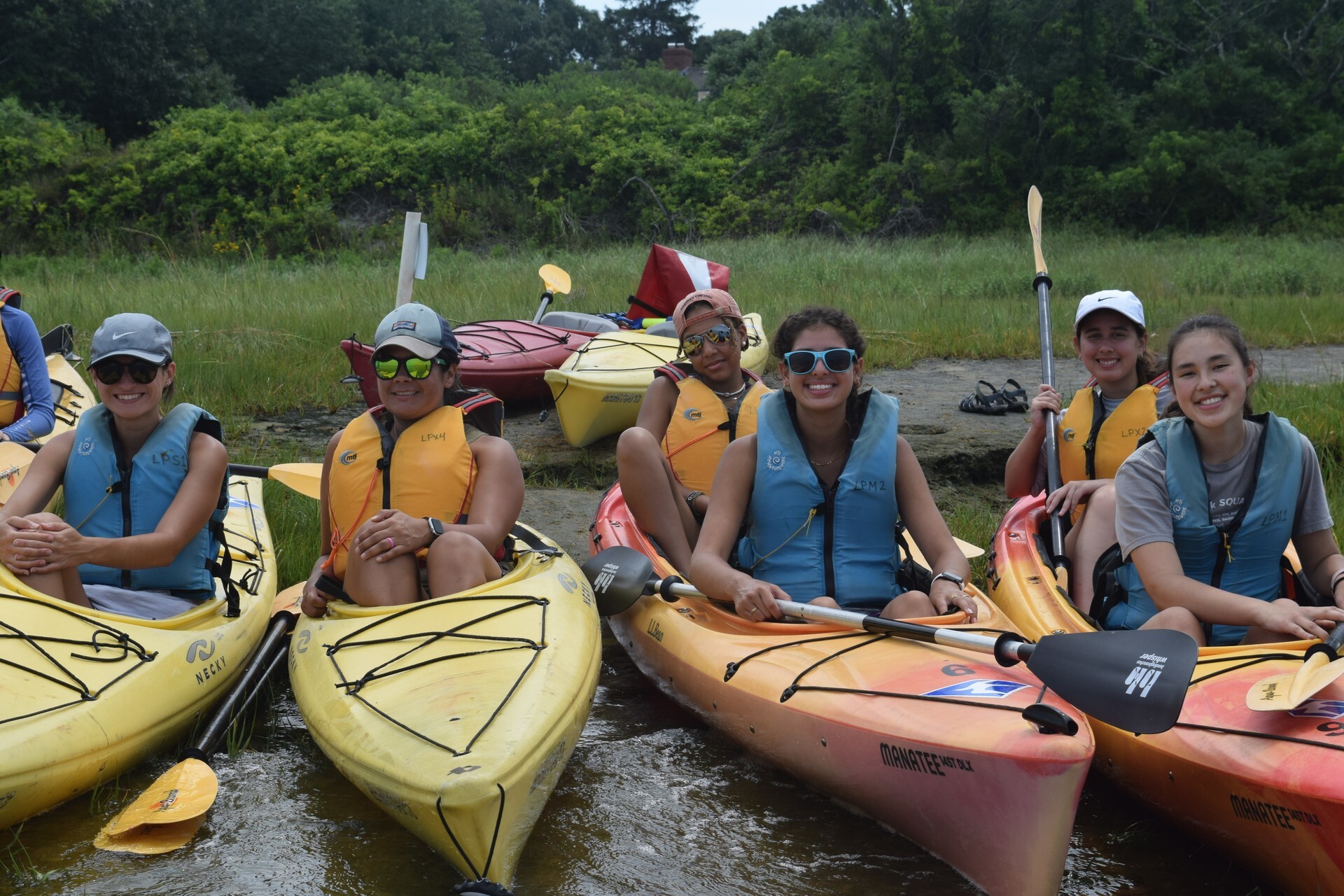
WHOI Sea Grant events have included public lectures, guided walks
and kayak tours, poetry readings with an ocean theme, art contests,
and public exhibits.
- Publication of a national Sea Grant careers booklet, Marine
Science Careers: A Sea Grant Guide to Ocean Opportunities, first
in 1995 and revised in 2000. A companion website debuted in 1999,
www.marinecareers.net.
The guide and the website are in use worldwide and, in addition
to Sea Grant channels, are distributed by government agencies,
public and private aquaria, museums, parks, and science centers.
During the academic year, the site received nearly 70,000 hits
per month and this figure is expected to rise.
- Support for educators, ranging from resource materials and
bibliographies, lending libraries, and classroom presentations,
has always been a high priority area for WHOI Sea Grant, and all
staff members actively participate in classroom and informal education
opportunities.
Investment in Education
Graduate Student Support*: 75 students; 308.95 months
Undergraduate Student Support*: 15 students; 29.25
months
Dean John A. Knauss Fellows: 4 students; 48 months
(1996 - 2, 1998 - 1, 1999 -1)
Other Fellowships: 2 students; 36 months
(Sea Grant/National Marine Fisheries Service, 2000 - 1; Coastal
Management Fellowship, 1997 - 1)
*The graduate student and undergraduate totals represent
students whose research was supported on Sea Grant-supported research
projects in each of our program's thematic areas.
Teacher Training Workshops on:
- Spineless Science: An Introduction to Classification Using Marine
Invertebrates (2000)
- Fish Printing in the Classroom (1999-present)
- Massachusetts Aquaculture in the Classroom (1998-99)
- Integrating Science and the Arts (1998)
- Aquaculture (1998)
- Shellfish Biology (1999)
- Introduction to the Internet (1995)
- Marine Science Careers (1995-present)
- Coastal Geology (1990-present)
What it Cost
Communications Support (1990-2000): Sea Grant-$753,338; Match-$437,938
Marine Education Support (1990-2000): Sea Grant-$135,567; Match-$286,177
Extension Support (1990-2000): Sea Grant-$928,065; Match-$309,917
Totals: $2,851,002
|