<?php
$title='INTERNAL TIDES'; 
include ('../includes/head_1level.php');
?>

<h2><?php echo $title; ?></h2>

<!-- START MAIN CONTENT -->

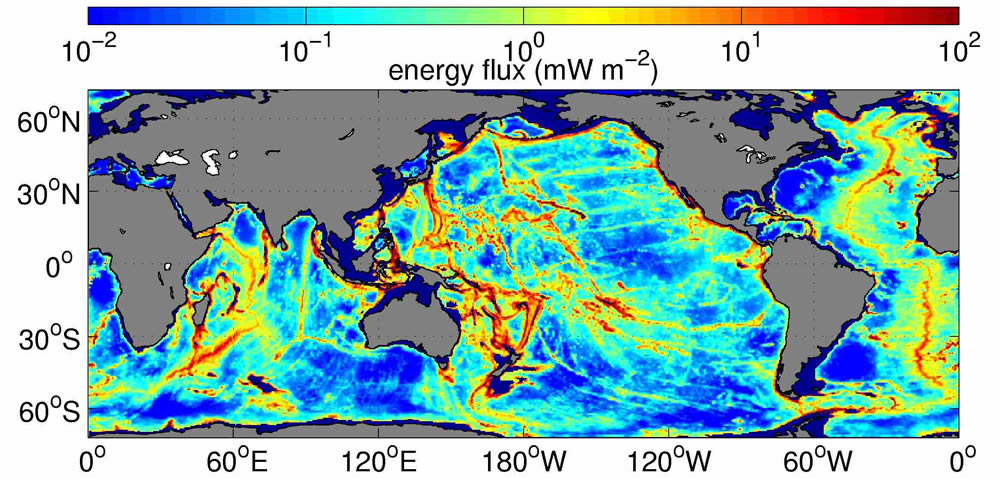
<p align="center"> <a href="images/internal_tides-LG.jpg"  rel="lightbox" title="Energy flux of the internal tides as estimated from a parameterization of internal wave drag in a forward model for the barotropic tides."><img src="images/internal_tides.jpg" alt="internal tides" /></a></p>

<p><strong>Energy flux of the internal tides as estimated from a parameterization of internal wave drag
  in a forward model for the barotropic tides. Globally, deep ocean internal tides extract roughly
  1 Terrawatt of energy from the surface tide (<a href="download/papers/jayne+stlaurent.2001.pdf">Jayne
  and St. Laurent 2001 <img src="images/general/pdf.gif"  alt="download pdf" height="10" /></a>).</strong></p>
<p>Internal waves are an ubiquitous class of oceanic phenomena, where wave motion transfers energy and
  momentum in the deep interior of the sea. Internal tides are generated at regions where the barotropic
  tidal current encounters variations in bottom topography. The resulting waves arise at the dominant
  tidal bands. The principle lunar semidiurnal (M2) and the lunar-solar diurnal (K1) are generally the
  most significant constituents in many locations. Since the diurnal and Coriolis frequencies are equal
  at roughly 30°, freely radiating diurnal internal tides are possible only equatorward of this latitude.
  This accounts for roughly half the ocean area, and semidiurnal internal tides are freely radiating
  over nearly all of the oceans, to 75&deg; latitude. </p>
<p>The internal wave energy spectrum is generally  &quot;red,&quot; with most energy tied to low baroclinic
  modes of the internal tide with horizontal wavelengths between 10 and 100 km. At these scales, waves
  are very stable. A considerable succession of physical processes must be implicated to cascade low-mode
  energy to the scales where instability can act to produce turbulence. </p>

<h3>Reviewed Publications</h3>

<p>St. Laurent, L. and J. Nash, 2004. An examination of the radiative and dissipative properties of the
  internal tides. Deep-Sea Research II, 51, 3029&mdash;3042, doi:10.1016/j.dsr2.2004.09.008.</p>
<p><a href="download/papers/simmonsetal.2004.pdf">Simmons, H. L., S. R. Jayne,
    L. St. Laurent, and A. Weaver, 2004. Tidally driven mixing in a numerical model of the ocean general
    circulation. Ocean Modelling, 6, 245--263, doi:10.1016/S1463-5003(03)00011-8. <img src="images/general/pdf.gif" alt="download pdf" /></a></p>
<p>St. Laurent, L., S. Stringer, C. Garrett, and D. Perrault-Joncas, 2003. The generation of internal
  tides at abrupt topography. Deep-Sea Research I, 50, 987--1003, doi:10.1016/S0967-0637(03)00096-7. </p>
<p><a href="download/papers/stlaurentetal.2002.pdf">St. Laurent, L., H. L.
    Simmons, S. R. Jayne, 2002. Estimating tidally driven mixing in the deep ocean. Geophysical Research
    Letters, 29, 2106-2110, doi:10.1029/2002GL015633. <img src="images/general/pdf.gif" alt="download pdf" /></a></p>
<p><a href="download/papers/stlaurent+garrett.2002.pdf">St. Laurent, L., and
    C. Garrett, 2002. The Role of Internal Tides in Mixing the Deep Ocean. Journal of Physical Oceanography,
    32, 2882-2899. <img src="images/general/pdf.gif" alt="download pdf" /></a></p>
<p><a href="download/papers/garrett+stlaurent.2002.pdf">Garrett, C., and L.
    St. Laurent, 2002. Aspects of Deep Ocean Mixing. Journal of the Oceanographic Society of Japan, 58,
    11-24. <img src="images/general/pdf.gif" alt="download pdf" /></a></p>
<p><a href="download/papers/stlaurentetal.2001.pdf">St. Laurent, L., J. M.
    Toole, and R. W. Schmitt, 2001. Buoyancy forcing by turbulence above rough topography in the abyssal
    Brazil Basin. Journal of Physical Oceanography, 31, 347-3495. <img src="images/general/pdf.gif" alt="download pdf" /></a></p>
<p><a href="download/papers/jayne+stlaurent.2001.pdf">Jayne, S. R., and L.
    St. Laurent, 2001. Parameterizing Tidal Dissipation Over Rough Topography. Geophysical Research Letters,
    28, 811-814. <img src="images/general/pdf.gif" alt="download pdf" /></a></p>
<h3>Additional Publications</h3>
<p><a href="download/papers/jayneetal.2004.pdf">Jayne, S. R., L. C. St. Laurent,
    and S. T. Gille, 2004. Connections between ocean bottom topography and Earth's climate. Oceanography,
    17, 65--74. <img src="images/general/pdf.gif" alt="download pdf" /></a></p>
<p>St. Laurent, L., and J. Nash, 2003. On the fraction of internal tide energy dissipated near topography.
  In Proceedings of the 'Aha Huliko'a Hawaiian Winter Workshop, 45--58.</p>
<p>St. Laurent, L., and C. Garrett, 2002. Energy dissipation by internal ocean tides. Bulletin of the
  American Meteorological Society, 83, 1457--1458.</p>

<!-- END  MAIN CONTENT -->

<?php 
include ('../includes/foot_1level.php');
?>
