<?php 
$title='RESEARCH IN THE SOUTH CHINA SEA';
include ('../includes/head_1level.php');
?>

<h2><?php echo $title; ?></h2>

<!-- START MAIN CONTENT -->

<p>My work in the South China Sea is supported by the US Office of Naval Research program in physical
  oceanography. The study is part of a collaboration with numerous colleagues, most significantly Harper
  Simmons of the University of Alaska - Fairbanks (<a href="http://people.iarc.uaf.edu/~hsimmons/">http://people.iarc.uaf.edu/~hsimmons/</a>)
  and YuHuai Wang of National Sun Yat-Sen University (<a href="http://www.iut.nsysu.edu.tw/html/profile/yu_hwai_wang.html">http://www.iut.nsysu.edu.tw/html/profile/yu_hwai_wang.html</a>)</p>

<p>We have worked in the South China Sea in a series of research cruises since 2005. These studies have
  focused on the large amplitude internal waves that occur in this region. A very nice presentation on
  the topic is given by Chris Jackson of Global Ocean Associates (<a href="http://internalwaveatlas.com/Atlas2_index.html">
  http://internalwaveatlas.com/Atlas2_index.html</a>).</p>

<p>Some aspects of the 2005 work along the shelfbreak region of the northern S. China Sea can be found
  here (<a href="http://ocean.fsu.edu/~lous/download/papers/stlaurent.2008.pdf">a description of results from the 2005 study can be found here</a>). I will focus here on the work
  done in 2007 and 2008, in the region of Dongsha Reef. This region gets hit my some of the largest internal
  waves occurring in the global ocean, and there is considerable evidence that nearly all aspects of
  the oceanography of the region are influenced by the internal waves, including aspects of the coral
  reef. </p>

<p align="center"><a href="images/dongsha_reef_map-LG.png" rel="lightbox[scs]" title="This map shows the survey regions for turbulence measurements in the South China Sea during 2007 and 2008."><img src="images/dongsha_reef_map-SM.png" alt="map"  width="600" /></a> </p>

<p>This map shows the survey regions for turbulence measurements in the South China Sea during 2007 and
  2008. The Taiwan research vessel OR3 surveyed sites east of Dongsha Reef in 2007, with waves measured
  at the 250-m and 900-m isobaths. During 2008, the Taiwan research vessel OR1 surveyed the region along
  the previously established APL/UW mooring (MP1 and MP2) and ADCP long-ranger (LR1-LR3) line. The 2008
  measurements tracked wave packets from the 550-m to 375-m isobath.</p>

<p align="center"><a href="images/900m_isobath_dongsha_plateau-LG.png" rel="lightbox[scs]" title="Here is a composite data section showing the classic South China Sea depression wave."><img src="images/900m_isobath_dongsha_plateau-SM.png" alt="900m isobath on Dongsha Plateau" width="600" height="278" /></a></p>

<p>Here is a composite data section showing the classic South China Sea depression wave. The wave is
  visible in the undulations of the backscatter intensity. In this case the wave has nearly 100-m displacement
  amplitude in 900-m of water. The turbulence levels observed in the core and wake of the wave are among
  the largest turbulence levels ever observed in open (non-coastal and non-bottom boundary layer) waters.</p>

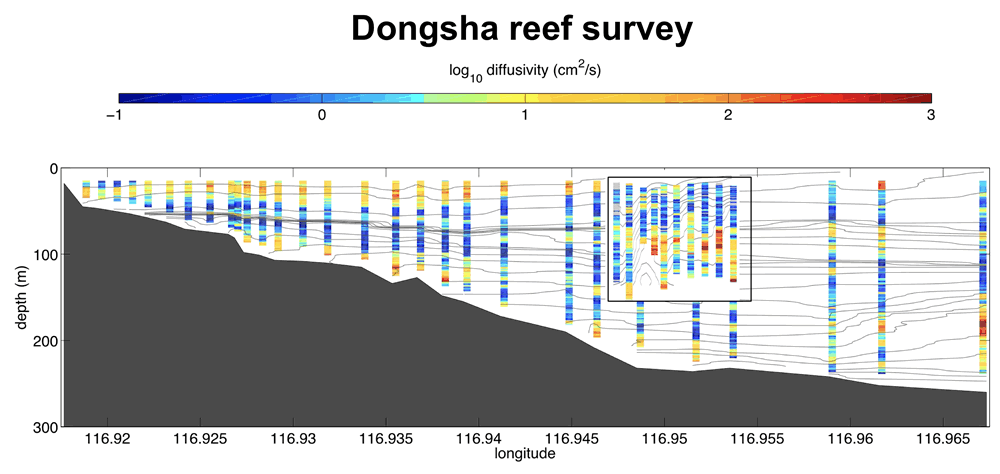
<p align="center"><a href="images/dongsha_reef_survey-LG.png"  rel="lightbox[scs]" title="Our survey directly east of Dongsha Reef was done between depression wave arrivals."><img src="images/dongsha_reef_survey-SM.png" alt="Dongsha Reef survey" width="600" height="323" /></a></p>

<p>Our survey directly east of Dongsha Reef was done between depression wave arrivals. With no wave present,
  most of the enhanced turbulence occurred in the upper and bottom boundary layers. </p>

<p align="center"><a href="images/250m_isobath_dongsha_reef-LG.png"  rel="lightbox[scs]" title="The wave we observed just east of Dongsha Reef at the 250-m isobath was more disorganized than the wave we observed at 900-m."><img src="images/250m_isobath_dongsha_reef-SM.png" alt="250m isobath off Dongsha Reef" width="600" height="281" /></a></p>

<p>The wave we observed just east of Dongsha Reef at the 250-m isobath was more disorganized than the
  wave we observed at 900-m. This is presumably due to changes in the wave that occur as it shallows.
  Interestingly, the turbulence levels in this wave are no greater than those observed in deeper water.</p>

<p align="center"><a href="images/dongsha_reef_survey_2-LG.png"  rel="lightbox[scs]" title="The diffusivity levels along the eastern edge of the Dongsha Reef are shown for the period both before and during the arrival of a large amplitude wave."><img src="images/dongsha_reef_survey_2-SM.png" alt="Dongsha Reef survey" width="600" height="284" /></a></p>

<p>The diffusivity levels along the eastern edge of the Dongsha Reef are shown for the period both before
  and during the arrival of a large amplitude wave. Diffusivities at mid-depth were enhanced by a factor
  of 10 to 100 when the wave passed.</p>

<p align="center"><a href="images/biological_wave_dongsha_reef-LG.png"  rel="lightbox[scs]" title="The biologic cycle at Dongsha Reef may be strongly influenced by the internal wave processes."><img src="images/biological_wave_dongsha_reef-SM.png" alt="biologic cycle at Dongsha Reef influenced by internal wave processes" width="600" height="450" /></a></p>

<p>The biologic cycle at Dongsha Reef may be strongly influenced by the internal wave processes. The
  work of YH Wang (NSYSU) suggests that wave processes trigger cycles of primary production, shown here
  via chlorophyll concentrations. </p>

<p align="center"><a href="images/OR1-LG.jpg"  rel="lightbox[scs]" title="Ocean Researcher I"><img src="images/OR1-SM.jpg" alt="Ocean Researcher I" width="400" height="300" /></a></p>

<p>The Taiwan research vessel Ocean Researcher I. </p>
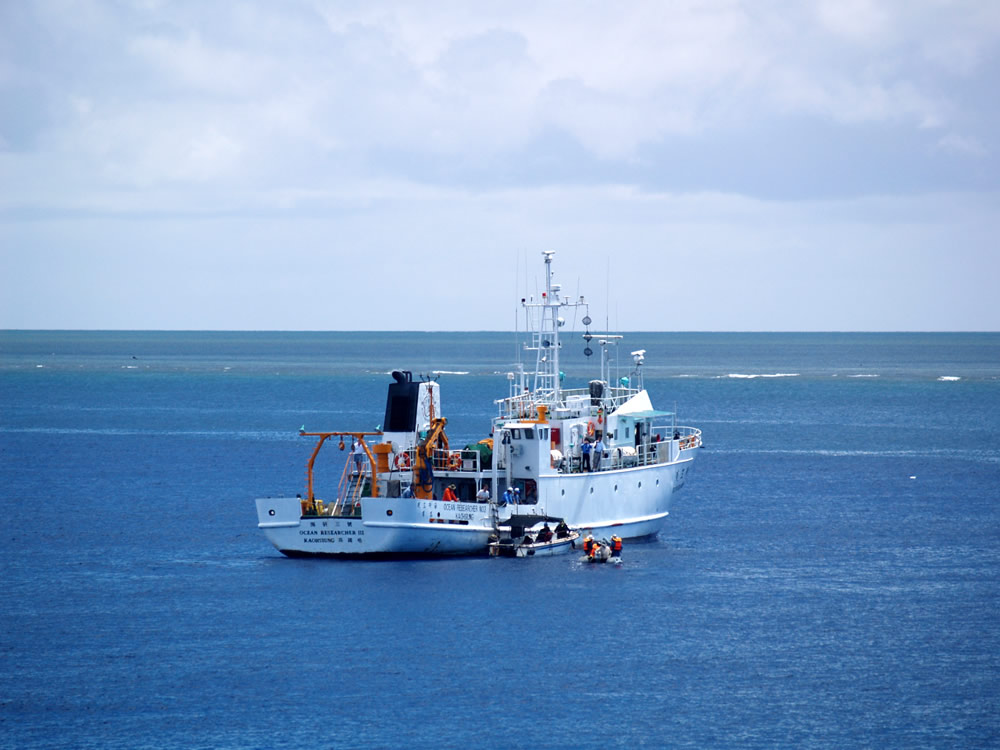
<p align="center"><a href="images/OR3-LG.jpg"  rel="lightbox[scs]" title="Ocean Researcher III"><img src="images/OR3-SM.jpg" alt="Ocean Researcher III" width="400" height="300" /></a></p>

<p>The Taiwan research vessel Ocean Researcher III.</p>

<p align="center"><a href="images/profiler-LG.jpg"  rel="lightbox[scs]" title="Rockland Scientific VMP-500 turbulence profiler."><img src="images/profiler-SM.jpg" alt="Rockland Scientific VMP-500 turbulence profiler" width="300" height="400" /></a></p>

<p>The Rockland Scientific VMP-500 turbulence profiler used by FSU during 2008.</p>

<p align="center">
  <script src="includes/js/AC_QuickTime.js" language="javascript" type="text/javascript"> </script>
  <script language="javascript" type="text/javascript">
    QT_WriteOBJECT('images/wave_movie.mov' , '650', '500', '');
  </script>
  <a href="images/wave_arrives-LG.jpg"  rel="lightbox[scs]" title="wave arrives"></a> <br />
  The movie above requires a Quicktime plugin for viewing. <a href="http://www.apple.com/quicktime/download/" target="_blank">Download
  one here</a>. </p>

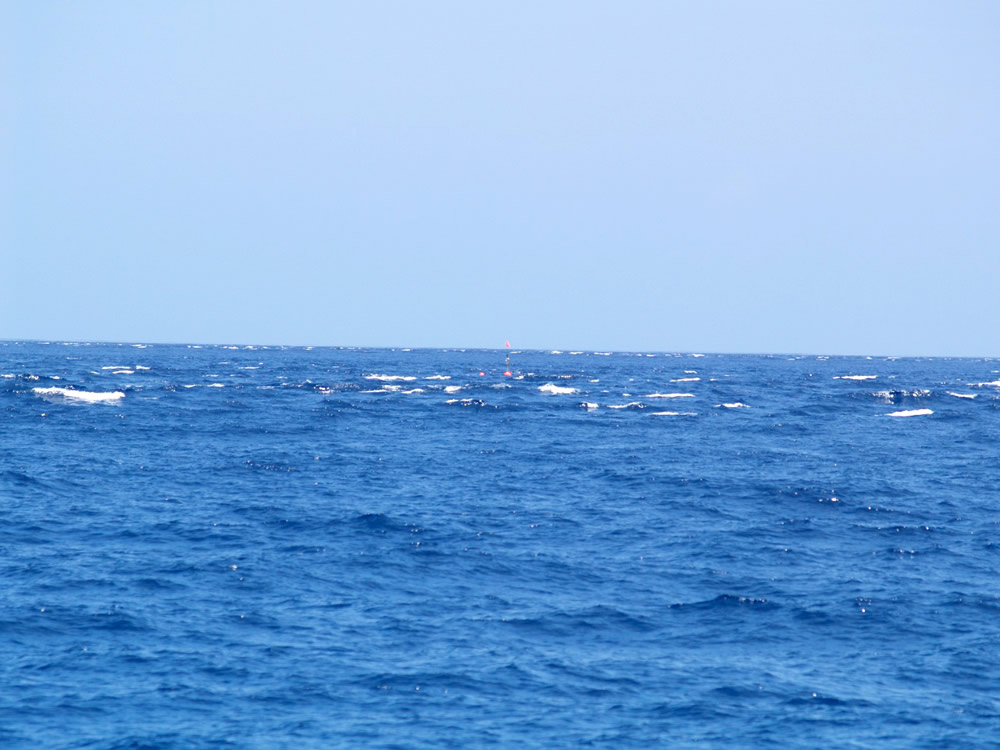
<p>The breaking wave front indicates the arrival of a large internal wave. There was no wind acting at
  the time of this picture.</p>

<p align="center"><a href="images/shipwreck-LG.jpg"  rel="lightbox[scs]" title="shipwreck"><img src="images/shipwreck-SM.jpg" alt="shipwreck" width="400" height="300" /></a></p>

<p>One of the many ship wrecks of Dongsha Reef. </p>
<!-- END MAIN CONTENT -->

<?php 
include ('../includes/foot.php');
?>