Lat/Long: S63°
45.619' W62° 30.856'
Wind: 12-14kn
Air Temp: -3.3°C Wind Chill: -14.8°C
Surface Water Temp: -0.066°C
Day's menu: Fried chicken, baked fish, Spanish
rice, carrots, green beans, cheesecake, bread pudding, banana
bread and cookies; Spaghetti and meatballs, spaghetti and clam
sauce, carrots, spinach, chicken noodle soup, and dessert from
lunch.
Reminder: To see this Journal and related
info on the web (feel free to share): http://www.whoi.edu/sites/antarctica
To Write Questions to the Ship/Outreach (through June 14 only):
outreach@lmg.usap.gov.
» View additional images from today
We are steaming southwesterly in the Palmer Archipelago, toward
Brabant Island, and we will do stations along the way. We can
see the Brugmann Mountains on Liège Island to our port
side. As the sun shines down on them from somewhere above the
low clouds that obscure the enormous white peaks of those tall
mountains, the day dawns and plankton nets are out. The mountains
are about 22 miles away, probably partially obscured by the
horizon at that distance, but the air is so clear here. I doubt
I can capture it on film, but it is surely burned into my memory,
I watched for so long.
The stature of these mountains should come as no surprise
to us did you know Antarctica is the tallest continent? It
has a majority of the highest peaks and plateaus in the world,
making it average higher than any other continent. In the
winter, the continent about doubles its size due to the freezing
of the waters surrounding it (and this is considered to add
to its land mass). Conversely, the continent shrinks to half
it's winter size due to the 'melt down' in the summer months.
We're hoping the winter freeze will hold off long enough for
us to get south of the Antarctic Circle, to Marguerite Bay,
over the next couple of days.
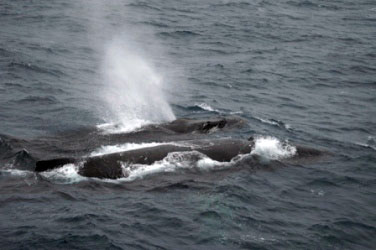
Humpback whales checking us out. (Photo
by Andy Mahon)
|
I woke up this morning to a whale sighting (thank you, Pam
P.)!! The waters were very calm except for some swell, and
four humpbacks were feeding right off the starboard aft quarter
while we were slowed for a plankton trawl. There was a huge
male with 3 smaller companions who didn't identify themselves.
Oh my, ohhhh my! They lingered and blew and dove, and made
a couple of 'bubble nets' for herding krill (we think) as
they went along. Wikipedia describes this as: "Its most
inventive feeding technique is called bubble net fishing.
A group of whales swims rapidly in wide circles around and
under a school of fish, blowing air through their blowholes.
The bubbles form a visual barrier that serves to confine the
school within an ever-tighter area. The whales then suddenly
swim upwards and through the bubble net, mouths agape, swallowing
thousands of fish in one gulp." I definitely saw bubble
nets twice, but one at a time. (We're thinking it was krill
the whales were chasing, as krill was evident in the plankton
tows, and we've not seen fish.) The humpbacks were unmistakable
in their display of very long pectoral fins with white undersides.
At one point from the Bridge, a fin on a dallying whale looked
like a plankton net a few meters down in the clear water,
and the Mate thought the whale had snagged the plankton net.
He had to call the aft deck to be sure the net was accounted
for, which it was. What a way to start your day, with a nice
cup o' frolicking leviathans.
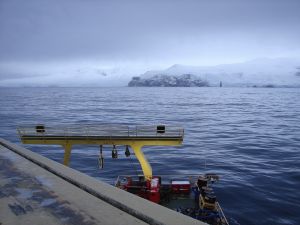
Brabant Island and 'Astrolabe Needle' (Photo by Janis
Umschlag)
|
Brabant Island is a beauty. Our waypoint for that station
kept us just off of the Pasteur Peninsula for a few hours,
with a lovely view of Astrolabe Needle. This is a freestanding
column of rock over 300 feet high. I'm told it is a regular
destination for cruise ships. For us, it was a very compelling
backdrop on a smooth-oceaned day.
Getting to Know You
[These are the first few respondents to a general request
to submit a brief summary of 'who you are, how you got here,
and what will you do with this experience when you get home'.
Jennifer Putland
My purpose on this cruise is to assist Dr. Rudi Scheltema
sort through plankton samples in search of larvae of benthic
invertebrates. I am also collecting my own samples to assess
the qualitative composition of mesozooplankton in different
waters. I am a post-doctoral fellow from Harbor Branch Oceanographic
Institute.
Andrew Mahon
I met Ken a few years ago at a conference, and late last winter
and early this spring, I emailed him about potential Post-doc
opportunities. We talked about ideas and about my prior interests
in the Antarctic. One thing came to another and I was asked
along on this trip as a start to collections for some post-doctoral
research that I will begin at Auburn in the next few months
following the completion of my dissertation.
Nicole Cox
I am an undergraduate at Auburn University in the marine biology
program. I work in Ken Halanych's lab studying Sterechinus
neumayeri (sea urchin common in the Antarctic). This is my
first research cruise and I hope to use this experience to
further my education in research. I will graduate in December
and continue on to grad school, although definitive plans
have not been made as to where I will attend.
Maxim Nikurashin
I am a fourth year Physical Oceanography student in MIT/WHOI
Joint Program. Working on my thesis I study generation, propagation
and breaking of quasi-steady internal waves in abyssal Drake
Passage. I volunteered to help with collecting and interpretation
of XBT, CTD and ADCP data on this cruise. This cruise gives
me an opportunity not only to get data collecting experience
but also to learn about the properties and dynamics of the
ocean in this region. I believe this is a great experience
for my future career as a physical oceanographer.
back
|
 Antarctica Invertebrates