
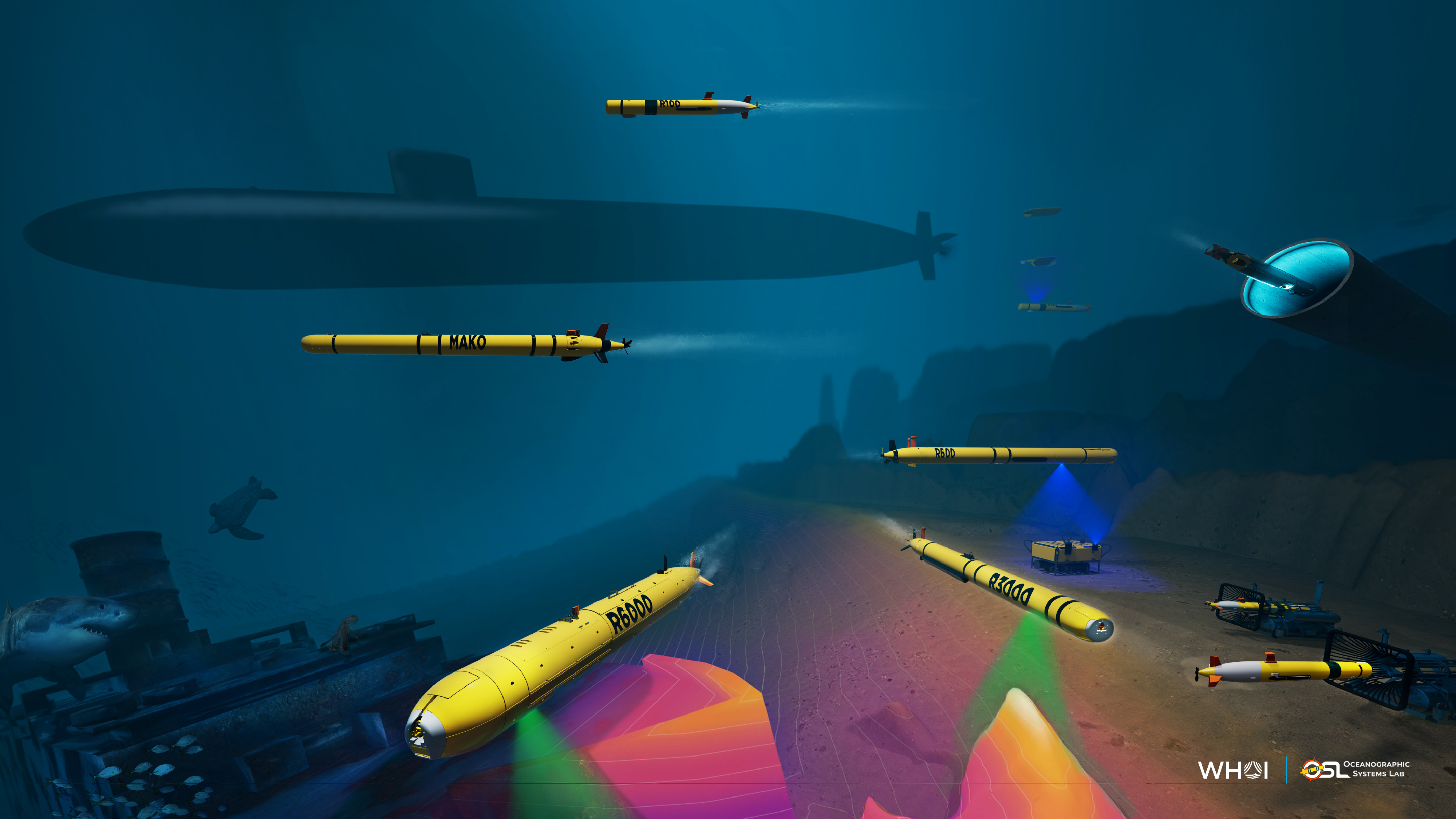
At the Oceanographic Systems Lab (OSL) a team of engineers, technicians and staff define Autonomous Underwater Vehicle (AUVs) concepts and build them into reality. Starting off with a small 100 meter depth rated two person portable vehicle just ten years ago, our team now designs larger more powerful vehicles designed to visit depths up to 6000 meters. Our mission is to provide the latest and most cutting edge technology for AUVs and their objectives relating to science and military applications. What is REMUS? Remote Environmental Monitoring UnitS These low-cost autonomous underwater vehicles are designed by OSL personnel to operate simply with a laptop computer. At less than 80 lbs, the lightweight design facilitates launch and recovery operations. A standard configuration carries an up- and down-looking Acoustic Doppler Current Profiler (ADCP), sidescan sonar, a CT profiler, and a light scattering sensor. Many other instruments have been integrated since its inception, including fluorometers, bioluminescence sensors, radiometers, acoustic modems, forward-looking sonar, altimeters, and Acoustic Doppler Velocimeters (ADVs). REMUS can also carry a video plankton recorder, a plankton pump, video cameras, pop-up cameras, an electronic still camera, and most recently, a towed acoustic array, making it a versatile tool for any mission. Because REMUS is so easy to use, a large number of non-technical personnel have been taught to operate the vehicle. This simplicity is evident in its mission programming, operation, recovery, and data downloading and analysis. Routine maintenance consists of washing it down with a hose and recharging the batteries, which does not require opening the housing, but merely plugging in a cable and pressing a button. As a result, it is an extremely reliable vehicle. REMUS has surveyed areas up to 80 kilometers at 3 knots or more than 100 kilometers at lower speeds. A standard vehicle equipped with an up/down-looking ADCP and sidescan sonar can run for more than 8 hours at 5 knots, or up to 20 hours at 3 knots. Unmodified, the REMUS vehicle is 52 inches long with a body diameter of 7.5 inches. The vehicle's length may be increased to support any payload within reason. Because REMUS is small, it can easily be transported in a compact car, air shipped as baggage, even Fedexed overnight, then launched and recovered from a small vessel. Special handling equipment is not required. Although small in size, REMUS is currently configured to support a variety of sensor packages. The REMUS control computer is based around PC-104 technology. The CPU sits on a custom motherboard with eight 12-bit analog to digital channels, I/O ports, power supplies, and other interface circuitry. The user interacts with REMUS through its diagnostic software and communicates via an RS-232 serial link. The REMUS vehicle interface program (REMUS VIP) is designed to run on a laptop equipped with Windows XP. The diagnostic software performs several functions including: displaying the status of all REMUS sensors; providing direct control of the vehicle via buttons and sliders; downloading mission files that tell REMUS the route to follow and the location of transponders; displaying the status of all major sub-systems and diagnostic messages; and playback of telemetry data as recorded by the vehicle during a mission. This allows users to operate and maneuver REMUS while obtaining data that can be plotted and displayed or exported in a variety of formats. Building on REMUS Technology
The Semi-Autonomous Mapping System Vehicle REMUS 6000, the Tunnel
Inspection Vehicle (TIV) and REMUS 600 are recent additions to the
REMUS family at WHOI's Oceanographic Systems Laboratory. These vehicles
demonstrate the manner in which REMUS technology can easily be adapted
to larger vehicles better suited to performing more specialized tasks.
Any vehicle that is larger than REMUS has the ability to travel
farther, go deeper, and carry a more complex set of sensors. Larger
AUVs like REMUS 6000, TIV and REMUS 600 are designed for a greater
depth rating and payload capacity than the standard REMUS-100. And,
yet, all vehicles use the same VIP (Vehicle Interface Software) and
auxiliary tracking equipment.
October 2, 2006 Vehicle Update
Last updated: November 30, 2012 | |||||||||||||||||||||||||||||||||
Copyright ©2007 Woods Hole Oceanographic Institution, All Rights Reserved, Privacy Policy. |